Tsiyon Messianic Radio Newsletter - Vol 20.14 - 01/14/6024
TAM - 04/12/2025 AD
|
|
 |
|
|
|
|
From Eliyahu
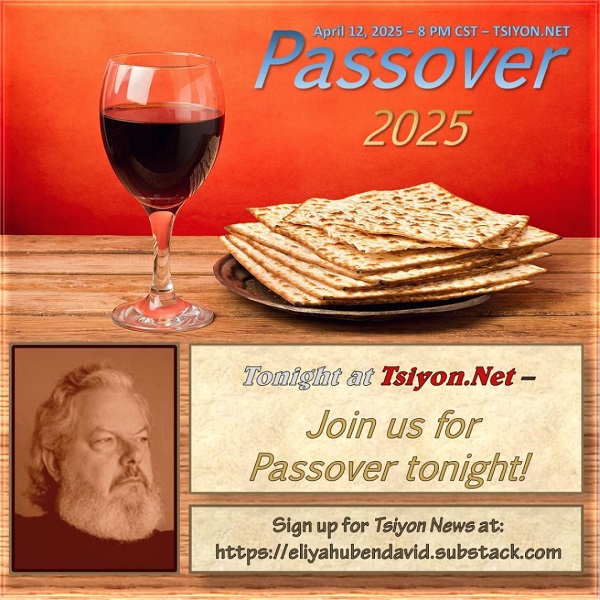
Tonight is Passover and you are
invited to join us via our live stream!
I'll give you all the
particulars about that a bit later in this newsletter, but 1st let's
consider one of the main objections to Passover we've all heard from some of
our friends and relatives. Typically, that objection goes something like
this:
"Passover is just for the Jews, so I don't celebrate that. We
Christians celebrate Easter. The apostle Paul didn't celebrate Passover
either, because, as Paul explained, the Law does not apply to those who
are saved through faith in Christ." - (Many sincere Christians)
Christians may be surprised to learn that they (sort of) already celebrate a
version of Passover, which they call "Easter" - at least according to the
King James Version (KJV) Bible. The word "Easter" appears in only one
place in the KJV Bible, and that is quoted below:
"And when he had apprehended him, he put him in prison, and delivered
him to four quaternions of soldiers to keep him; intending after
Easter to bring him
forth to the people." (Acts 12:4 KJV)
Strong's Exhaustive
Concordance of the Bible lists every word in the KJV Bible and assigns a
number to it. That number, in turn, lists the Hebrew or Greek word that the
English word is translated from, along with the definition of the original
language word. For example, in the verse above Strong's indicates the
word "Easter" is translated from the Greek word: G3957 Pasha. The
definition Strong's gives of that word is "the Passover."
Interestingly, the New King James Bible (NKJV) departed from the use
of the English word "Easter" in that verse, and uses the word "Passover"
instead, as does every other modern English language Bible I've checked this
in.
Actually, many Christian reference works continue to use the word "Easter"
in the same way as the KJV did, even putting this word "Easter" in the
mouths of so-called "early Christians". This gives the impression that
"early Christians" celebrated a holiday other than Passover called "Easter"
- which some now call "Resurrection Day".
Historically speaking, "Easter" in Christianity did not arise until hundreds
of years after the time of Christ, in the early medieval period. The
earliest recorded use of "Easter" as Christian celebration can be traced
back to the Venerable Bede, an Anglo-Saxon monk and historian, in his work
De Natura Rerum written in the 8th century (approximately 731 AD).
Bede noted that the term "Easter" was derived from the name of the pagan
goddess Eostre, associated with spring and fertility. Hence, the
bunnies and the colored eggs. This pagan festival was eventually adapted by
Christians to refer to the resurrection of Jesus Christ.
As the Bible faithfully records, Yeshua, His apostles, and other early
believers all kept the Passover. There was no dispute about this until well
after the apostles were dead, from the late 2nd century to the First Council
of Nicaea in 325 AD. This is called
The
Quartodeciman Controversy.
Basically, those disciples of
Yeshua who continued to follow the ways and teachings of the apostles
continued to keep Passover as the apostles had taught - on the 14th Day of
Aviv (Nisan). This date was set using the Bible's lunar calendar, as
originally set according to Scripture. The Roman calendar didn't play nice
with the Bible's lunar dates. So, eventually the Gentile believers under the
influence of Rome preferred to move their celebration to the same day
as the sun worshippers of Rome, namely Sunday. This resulted in what was
essentially a new Gentile Christian holiday, which in turn, eventually
morphed into Easter.
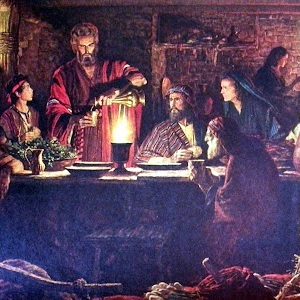
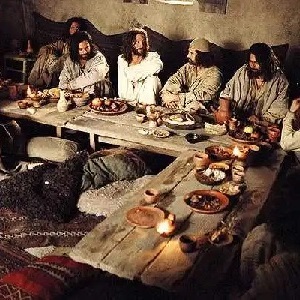
Moses, Yeshua and the Apostles Kept the Biblical Passover
|
Now, about the Apostle Paul. The
Apostle Paul, who was originally known as Saul of Tarsus, was a Jewish
Pharisee when he met the resurrected Yeshua and put faith in Him. His
relationship with Jewish law and traditions as opposed to the commandments
of YHWH as given in the Torah can be discerned through his writings in the
New Testament, as well as the accounts of his life in the Book of Acts.
Nevertheless, Paul is widely misunderstood, and always has been, even in his
own time. Peter put it like this:
"Regard the patience of our Lord as salvation; even as our beloved
brother Paul
also, according to the wisdom given to him,
wrote to you; as also in all of his letters,
speaking in them of these things. In those,
there are some things that are hard to understand, which the ignorant
and unsettled twist, as they also do to the other Scriptures,
to their own destruction." (2
Peter 3:15-16)
Paul was no intellectual
lightweight, he was well able to discern fine distinctions that others often
miss. For example, Paul wrote this:
"We, being Jews by birth,
and not Gentile sinners, yet knowing that
a
man is not justified by the works of the law but through faith in Yeshua
the Messiah, even we believed in Messiah
Yeshua, that we might be justified by faith in Messiah, and not by the
works of the law, because no flesh will be
justified by the works of the law."
(Galatians 2:15-16)
This emphasizes Paul's belief
that justification comes through faith rather than adherence to the Law.
This verse is often interpreted as meaning that observance of the law is no
longer necessary for righteousness. Yet, that is just an assumption, not
stated in the text. Paul himself didn't say that the Law (Torah) was
cancelled and no longer in effect. His comment here is limited to
Justification. He is asserting that you cannot justify yourself in the eyes
of God through works of the Law, but only through faith in Messiah. This
stops far short of saying the commandments of God are no longer in effect,
or are unimportant. Elsewhere Paul explained how the Law and the Spirit work
together. He said:
For what the Law couldn't do, in that it was weak through the flesh, God
did, sending his own Son in the likeness of sinful flesh and for sin, he
condemned sin in the flesh; that the
ordinance of the Law might be fulfilled in us, who walk not after the
flesh, but after the Spirit. (Romans 8:3-4)
This follows Paul's explanation
in Romans 7 explaining the trouble we have dealing with sin in our lives,
preventing us from keeping God's Law, even when we want to and we try to. In
the verses above Paul draws on the same thought, that the weakness of the
Law, preventing it from bringing us to full righteousness, is our own
"sinful flesh." That's why YHWH sent His own Perfect Son as the ultimate
Passover Lamb to save us from our sin. Having that atonement, through faith
in Messiah and His righteousness we receive the Holy Spirit. If we
then choose to keep "the ordinance of the Law" by .'walking after the
Spirit' we CAN fulfill the Law of God! This very statement of Paul assumes
the Law is still an active part of the Father's Plan.
But what about Paul observing Passover? Did he 'fulfill' Passover each year,
walking in the Spirit, or did he abandon Passover altogether? Some people
think Paul did not keep Passover and didn't want us to keep it either. They
sometimes quote this passage:
"Let no man therefore judge
you in meat, or in drink, or in respect of an holyday, or of the new
moon, or of the sabbath days: Which are a shadow of things to
come; but the body is of Christ." (Colossians 2:16-17 KJV)
As written, this verse seems to say that
the special days commanded in Scripture, such as Sabbath and Passover are no
longer valid, and are just a personal choice. Is that really what Paul was
saying?
No. That is not what Paul was saying. In
fact, I can prove that beyond doubt. I intend to do just that as part of my
Passover teaching this evening. Learn the facts about this favorite
Christian "proof text." You will find it is, in fact, a proof text, but it
proves something very different than is often claimed.
This seems a good place to give you the
rundown on our Tsiyon Passover plans for tonight. We will begin broadcasting
live from our membership sight at
TSIYON.NET starting at 8
pm CST and via Tsiyon Radio at
TSIYON.ORG. From 8 until about 9:30 we will be having our Passover meal
here at Tsiyon. After our live introduction we will be sharing our keynote
address entitled: Have We Been Told What Paul the Apostle Really
Said About Passover? This will be followed by worship music until we
share in the emblems of the New Covenant together at about 9:30 pm.
If your time zone works with these plans
it would be great if you could join us live for all or part of this special
occasion. If not, we will provide the video as soon as possible. Either way,
please feel free to send in your comments and prayer requests.
Let's recap:
8:00 pm CST: Our live Passover meeting
stream will be introduced.
Next: Opening Prayer
Next: Have We Been Told What Paul the
Apostle Really Said About Passover?
About 9:30 pm CST: New Covenant
observance with Matzos and Wine.
Conclusion: Prayer and worship
Where: live at
TSIYON.NET (video) and at
TSIYON.ORG (audio only)
We are excited to join with our Remnant family around the world this Passover.
Happy Passover!
Eliyahu
Tsiyon.Org
Join us for Passover Tonight!
|
|
 |
|
|
|
|
|
|
|
"Let them build Me a Sanctuary, that I may reside in their midst." Ex
25:8
| |
Thanks to our Tsiyon Ministry Partners for your support of this ministry!
Not a Tsiyon Ministry Partner yet? Visit our Tsiyon
Website
for full details.
|
|
|
|
|
|
|
Leave
feedback, prayer requests and comments
here.
You may unsubscribe
here.
|
|
|
Tsiyon
9901 Brodie Lane
Suite 160, Unit 1421
Austin, TX, USA, 78748
Please make offering checks to: "Tsiyon."
|
 |
 |
 |
|
|
|
|
|
|
|