https://tsiyon.org/images/230801NL/What makes a person mighty in the Scriptures, and why you should care.

TSIYON NEWS

Tsiyon Messianic Radio Newsletter  - Vol 20.22 - 03/14/6025 TAM - 06/10/2025 AD

Signs are everywhere


From Eliyahu


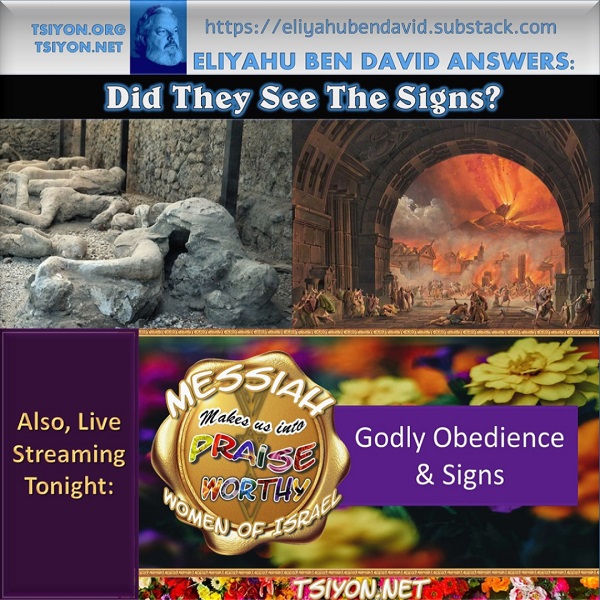
Pompeii, a vibrant Roman city nestled near the foot of Mount Vesuvius, met a sudden and tragic end on August 24, 79 AD. A massive eruption of the volcano blanketed the city under at least 19 feet (6 meters) of ash and volcanic debris, preserving it for centuries. When it came, the disaster was so swift that many residents were caught in the midst of their daily activities, their final moments tragically leaving behind hauntingly detailed remains.


We know about Pompeii’s destruction thanks to archaeological excavations and historical accounts. The city was rediscovered in the late 16th century, and systematic excavations began in the 18th century, revealing homes, streets, frescoes, and even the preserved forms of people and animals. The ruins of Pompeii offer an unparalleled glimpse into ancient Roman life.


Archaeologists have used a variety of methods to uncover Pompeii, transforming it from a buried city into one of the most well-preserved ancient sites in the world. Here are some key techniques:

  • Systematic Excavation: Early digs were often chaotic, but in the 19th century, Giuseppe Fiorelli introduced a structured approach, dividing Pompeii into regions and numbering buildings for precise documentation.


  • Plaster Casting: Fiorelli also pioneered the technique of pouring plaster into voids left by decomposed bodies in the ash, creating hauntingly detailed casts of Pompeii’s residents at the moment of their demise.


  • Stratigraphic Analysis: Archaeologists carefully study layers of volcanic material to understand the sequence of events during the eruption and the city's history before it.


  • Modern Technology: Recent excavations have used ground-penetrating radar and 3D scanning to map structures without disturbing them, revealing hidden streets and buildings.


  • Material Analysis: Researchers have examined construction materials to understand Roman engineering techniques, including their innovative use of quicklime and pozzolana for cement-making.

These methods have helped archaeologists piece together Pompeii’s story, offering a vivid snapshot of Roman life frozen in time.


We also have written accounts from the period. One of the most famous firsthand accounts comes from Pliny the Younger, who described the eruption in letters to the historian Tacitus. His vivid descriptions of the ash cloud and the chaos provide a rare eyewitness perspective of the eruption of Mount Vesuvius in 79 AD. He was 17 years old at the time and staying with his uncle, Pliny the Elder, a renowned naturalist and naval commander. His descriptions, written in letters to the historian Tacitus about 25 years later, became crucial in understanding the disaster.


Pliny described the volcanic cloud as resembling an umbrella pine tree, rising high before branching out. His uncle, Pliny the Elder, set out on a rescue mission across the Bay of Naples but tragically died on the beach, likely due to inhaling toxic fumes. Meanwhile, Pliny the Younger stayed behind with his mother and later recounted his terrifying escape. He described how daylight was completely blocked, leaving them in darkness as ash rained down. His vivid memory of the eruption helped scientists classify similar volcanic events as Plinian eruptions.


Here’s a famous excerpt from Pliny the Younger’'s letter to Tacitus, describing the eruption of Mount Vesuvius in 79 AD:

“He was at Misenum in his capacity as commander of the fleet on the 24th of August, when between 2 and 3 in the afternoon my mother drew his attention to a cloud of unusual size and appearance... The cloud was rising from a mountain - we couldn't tell which, but afterwards learned that it was Vesuvius. I can best describe its shape by likening it to a pine tree. It rose into the sky on a very long 'trunk' from which spread some 'branches'..."

This passage vividly captures the moment Pliny the Elder first saw the eruption. His curiosity led him to launch a rescue mission, but he tragically died on the shore, likely due to toxic fumes.

Pliny the ElderStaying to help

Estimates have been offered of how many Pompeiians died in the disaster. Yet, the exact number remains uncertain. Archaeologists have uncovered the remains of over 1,500 people in Pompeii and Herculaneum. Some estimates suggest the total death toll could be as high as 16,000. The eruption buried the cities under volcanic ash and pyroclastic flows, preserving many victims in their final moments.


There were warning signs before Mount Vesuvius erupted, but most Pompeiians either didn’t recognize the signs or chose not to flee. Frequent earthquakes had been shaking the region for years, including a major one in 62 AD, which caused significant damage to the city. However, even then the people didn’t associate them with an impending volcanic eruption.


When the eruption began on August 24, 79 AD, some residents did try to escape, but most still stayed behind, believing the disaster would pass. Pliny the Younger described how his uncle, Pliny the Elder, initially saw the eruption as a scientific curiosity rather than a threat. While some Pompeiians may have fled in the early stages, the eruption intensified, and escape became impossible. The pyroclastic flow - fast-moving clouds of hot gas and ash - ultimately overwhelmed all those who remained.


The tragedy was worsened by a lack of understanding of volcanic activity. The people of Pompeii didn’t even know Vesuvius was a volcano - it had been dormant for centuries and was seen as just another mountain. Their trust in their gods and their belief that the city was protected also played a role in their decision to stay. It’s heartbreaking to think about how close they were to survival, yet how little they knew about the danger, having missed the earlier signs and the opportunity those signs afforded them to prepare and escape.


This phenomenon of ignoring warning signs of impending disaster is a strangely recurring theme in history. People often fail to recognize or act on warning signs of impending disasters, whether due to skepticism, or just the belief that things won’t get as bad as predicted. Pompeiians had lived with frequent earthquakes for years, so they may have simply adapted to them, not realizing they were foreshadowing something far worse.


It’s not just ancient history either - modern disasters show similar patterns. History is full of disasters that could have been prevented if warning signs had been heeded. Here are a few notable examples:

• Chernobyl Nuclear Disaster (1986) – Engineers and scientists raised concerns about the reactor’s design flaws, but Soviet officials ignored them. The result was one of the worst nuclear disasters in history.


• Indian Ocean Tsunami (2004) – Scientists had warned about the lack of an effective tsunami warning system in the region, but authorities failed to act. Over 230,000 people lost their lives.


• Hurricane Katrina (2005) – Meteorologists and engineers warned that New Orleans’ levee system was inadequate, but the warnings were dismissed. When Katrina struck, the city suffered catastrophic flooding.


• Aberfan Disaster (1966) – Residents had expressed concerns about the stability of a coal waste tip above their village, but officials ignored them. The tip collapsed, burying a school and killing 144 people, most of them children.


• Fukushima Nuclear Disaster (2011) – Experts warned that the nuclear plant was vulnerable to tsunamis, but cost-cutting measures prevented necessary upgrades. When a massive tsunami hit, the plant suffered meltdowns.


• Titanic Sinking (1912) – The Titanic received multiple warnings about icebergs in its path, but the ship continued at high speed. It struck an iceberg and sank, killing over 1,500 people.


• Challenger Space Shuttle Disaster (1986) – Engineers warned that cold temperatures could cause the shuttle’s O-rings to fail, but NASA proceeded with the launch anyway. The shuttle exploded 73 seconds after takeoff, killing all seven crew members.

Many more such cases could be listed, but this short list is enough to make the point.


Right now there are signs of impending disaster on many fronts. Some are being addressed, but following the pattern of the past, most are being ignored. Of greatest concern should be the warning signs of the End of the Age. These signs are in evidence right now, manifesting at an alarming rate. Do you see them? If you do, are you taking action to survive impending disaster? (Matthew 24)
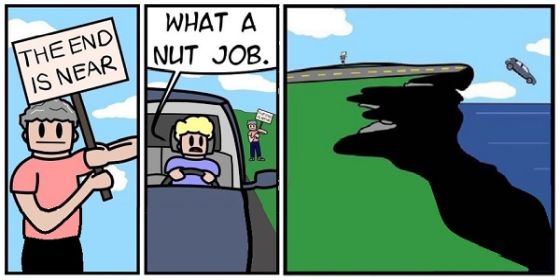
 

..Really.


In any of the cases listed above, if you had been there and observed the signs, how many people do you think would have agreed with you? Isn’t it more likely that you would have been scorned as a pessimist or extremist? The majority is not always right. Actually, the majority is seldom right. Do your research and use your brain. Trust in your Heavenly Father and trust the testimony of the Holy Spirit. The signs tell the story. The signs are everywhere. We are in the Last Days. Do something about it before it is too late. (Luke 21:34-36)


In His Name, Eliyahu


Join our live stream panel discussion Tonight - 8 PM Central - Tsiyon.Net

Join us tonight!

Audio: Listen to Tsiyon RadioTsiyon Radio on TuneInSpeakerStitcher.comVideo & Audio PodcastsSpotifyGoogle Video Podcasts

Video:  FaceBookTwitterRokuYouTubePeriscopeTwitchDive.TVPodChaser

PodBeanBuzzSproutApple Video PodcastsTruthPoint Video ChannelEliyahu ben David Author Page

"Let them build Me a Sanctuary, that I may reside in their midst." Ex 25:8


Thanks to our Tsiyon Ministry Partners for your support of this ministry!
Not a Tsiyon Ministry Partner yet? Visit our Tsiyon
Website for full details.

Copyright 2025 Tsiyon

Leave feedback, prayer requests and comments here.  You may unsubscribe here.

Please help keep Tsiyon on the air! 

 Click to Donate 

Tsiyon

9901 Brodie Lane

Suite 160, Unit 1421

Austin, TX, USA, 78748


Please make offering checks to: "Tsiyon."