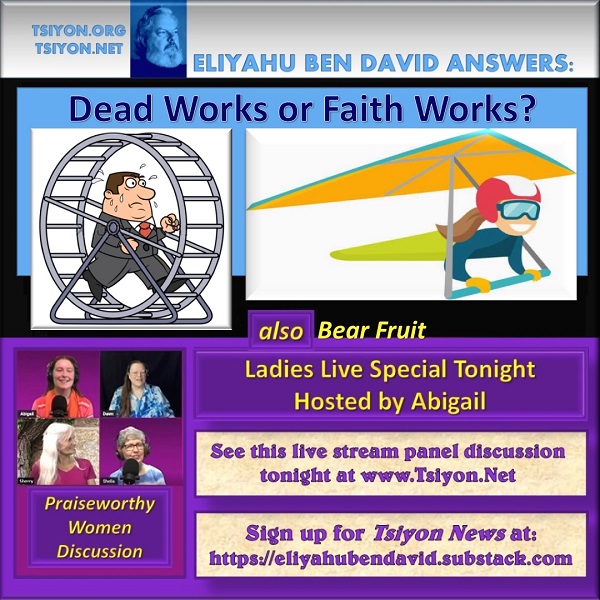
Tsiyon Messianic Radio Newsletter - Vol 20.26 - 04/14/6025
TAM - 07/09/2025 AD
|
|
 |
|
|
|
|
From Eliyahu
We all know, or should know, that salvation is by grace through faith, not
by works. Yet, Yeshua’s insistence on disciples bearing fruit can sound a
lot like works, so can create some confusion. If we don’t fully understand
the totality of this truth as regards bearing fruit, it can lead to the trap
of legalism. That is, the burden of “earning” our salvation, which has
proven to be impossible for imperfect humans to do.
The apostle Paul makes it crystal clear that our salvation is not by works:
“For by grace you have been saved through faith, and that not of yourselves;
it is the gift of Elohim, not of works, that no one may boast.” (Ephesians
2:8-9)
The Father extends the gift of salvation in His unmerited favor
extended to us (grace), by virtue of faith in the atoning sacrifice of
Yeshua for those who believe, not as a reward for our moral ledger. As Paul
argues in Romans: “There is no one righteous; no, not one… for all have
sinned, and fall short of the glory of Elohim.” (Romans 3:10, 23)
Yet even as we are thankful for grace, Yeshua and the Apostles insist that
genuine faith produces works as its natural fruit. James confronts a “dead
faith” that refuses to act: “You see that a person is justified by works and
not by faith alone” (James 2:24), adding, “Faith without works is dead”
(James 2:26). How do we reconcile Paul’s insistence that we’re not saved by
works with James’s insistence that true faith shows itself in deeds? “How
much more will the blood of Messiah, who through the eternal Spirit offered
himself without blemish to God, cleanse your conscience from dead works to
serve the living God?” (Hebrews 9:14)
And what are the dead works Paul mentions here? Is Paul speaking against the
Torah of Moses as synonymous with “dead works”?
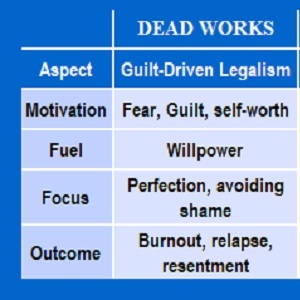
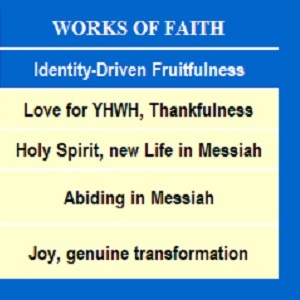
The key to all of this is distinguishing between two kinds of works:
-
Dead
Works are Meritorious Works
which we perform to earn God’s favor - these Scripture rejects
(Romans 4:4).
-
Faith
Works, Fruitful Works,
which flow from a heart transformed by grace - these God prepares
and delights to see (Ephesians 2:10).
When we rest in Messiah’s finished work and are united with Him by faith,
the Holy Spirit births good works through us. But when we attempt to earn
salvation through moral performance, we trap ourselves under the weight of
legalism and fear.
To understand how authentic fruitfulness arises, we turn to Yeshua’s vivid
picture in John 15. He declares, “I am the true vine, and my Father is the
Farmer” (John 15:1).
In this metaphor:
-
The
Vine
is Messiah Himself - our source of spiritual nourishment and Life.
-
The
Branches
are disciples, grafted into the Vine through faith.
-
The
Farmer
is the Father, cultivating, pruning, and overseeing every branch.
Yeshua continues: “Those who abide in me and I in them bear much fruit; for
apart from me you can do nothing” (John 15:5). Notice what He does not
say: “Work harder,” or “Perform more deeds.” He says, “Abide.”
To abide
means to remain, to dwell, to cultivate an ongoing relationship. Our
capacity to bear spiritual fruit - love, joy, peace, patience, kindness,
goodness, faithfulness, gentleness, self-control (Galatians 5:22–23) depends
entirely on our connection to Messiah. It is our manifestation of that
spiritual fruit within that enables us to sow the seed of the Word into
others, to bring forth other disciples as fruit for the Kingdom.
But what if we do not abide? Messiah warns, “Every branch in me that does
not bear fruit he takes away, and every branch that does bear fruit he
prunes, that it may bear more fruit” (John 15:2). Those who will not abide
He takes away, lest they become an impediment to other branches.
More often
though, troubled branches just need some pruning. Pruning often feels
painful - life’s trials, convictions of sin, the Lord removing certain good
things so that the best things might flourish. Yet pruning deepens our roots
and strengthens our capacity to bear more abundant fruit. Pruning can feel
awful, but it’s a good thing, because it will reestablish that pruned branch
in a more vital relationship to the Vine.
Finally, Yeshua promises: “If you abide in me, and my words abide in you,
ask whatever you wish, and it will be done for you” (John 15:7). This is not
carte blanche for self-serving desires but a guarantee that as we remain
rooted in His Life and Word, our deepest longings align with the Father’s
Will, and He brings increase for the Kingdom through our prayers.
Despite that clear picture from Messiah, many believers, though
well-intentioned, fall into the trap of guilt-driven effort. They
toil under the burden of perfectionism: “I must do more, be better, and earn
God’s approval.” Scripture warns against this legalism: “These are matters
of appearance… they lack any value in restraining sensual indulgence”
(Colossians 2:23).
Religion often promotes that guilt-driven effort for the
sake of building earthly kingdoms. Such guilt-driven effort is a curse,
because it is never satisfied, and it never leads to fulfillment. Trust me,
I know because I’ve been there, but thanks to the grace of Yeshua my Messiah
I was set free from that bondage into the glorious freedom of the sons of
Elohim. (Romans 8:15-17)
Paul was like I once was, in that he once was under the bondage of a false
religion that pushed a merit-based concept of salvation. The Jewish sect he
grew up under viewed the Torah of Moses as a checklist by which a Jew could
earn salvation. Paul was set free from that mentality by meeting the
resurrected Messiah, through whom he was saved by grace to do the will of
the Father, apart from keeping any checklist, including the Torah. Paul
said: “For as many as are of the works of the law are under a curse. For it
is written, cursed is everyone who doesn’t continue in all things that are
written in the scroll of the Torah, to do them.” (Galatians 3:10 CJB)
By this did Paul invalidate the Torah? Strangely, that seems to be the
general opinion of most Christian-based religions. However, they are missing
Paul’s real point which is: Paul, before he met Messiah, and other Jews as he
had been then, were “of the works of the Law” in that they were keeping
those works of the Law as the way to salvation. This was in fact a curse to
them because of sin, since the works of the law were not adequate to
overcome sin, so could not bring them to salvation.
|
The defect is not in the Commands of YHWH. The defect is in the sinner who
cannot attain salvation through the Torah. That does not invalidate the
Torah, it simply invalidates the mistaken attempt to be saved through works
of the Torah. In other words, there is nothing wrong with the Commandments,
it’s just that keeping the Commandments is not meant to be the way to bring
a person to salvation. Only Messiah can do that! (Duet 32:4-5)
Paul said this: “Is the law then against the promises of God? Certainly not!
For if there had been a law given which could make alive, most certainly
righteousness would have been of the law. But the Scriptures imprisoned all
things under sin that the promise by faith in Yeshua the Messiah might be
given to those who believe." (Galatians 3:21-22)
Paul and other believers continued to fulfill the Torah, but not for the
purpose of earning salvation, since that could only be through Messiah. They
did/do it a new way – by the Spirit. Paul explains: “For what the Torah
couldn’t do, in that it was weak through our flesh, Elohim did, sending his
own Son in the likeness of sinful flesh and for sin, he condemned sin in the
flesh; that the ordinance of the Torah might be fulfilled in us, who walk
not after the flesh, but after the Spirit.” (Romans 8:3-4)
“Walking after the Spirit” removes any burden from keeping His commands. The
Apostle John put it like this: “Everyone who believes that Yeshua is the
Messiah has God as his Father, and everyone who loves a father loves his
offspring too. Here is how we know that we love God's children: when we love
God, we also do what he commands. For loving God means obeying his commands.
Moreover, his commands are not burdensome” (1 John 5:1-3)
Summing up about the Commandments of the Torah: They were never meant to
save you, other than in your natural life. Eternal salvation only comes by
grace, through faith in Messiah. As for the Commandments, they are still of
Elohim and make for the best possible outcomes in this life. We walk in them by the Spirit out of
love for our Father – never out of guilt or fear. Because of grace in
Yeshua, we have room to grow in this as we mature in the faith.
Thus, we see that dead works are not the Commandments of YHWH. This would
mean that YHWH is confused within Himself, which He is not. Dead works are
any works, usually guilt or fear driven works done in an attempt to earn
salvation. Guilt-driven striving exhausts us. We obey out of fear of
punishment or fear of not measuring up. Performance becomes our master, and
our joy shrinks. Yet the Gospel declares something radically different. In
union with Messiah, His life, death,
and resurrection become ours:
-
We
were buried with Him by baptism into death, “so that… we too might walk
in newness of life” (Romans 6:4).
-
“I
have been crucified with Messiah. It is no longer I who live, but
Messiah who lives in me” (Galatians 2:20).
This union is not an abstract theological fact but the foundation of our
true identity. When we grasp that our old, guilt-laden self has been
crucified, and our new self is alive in Messiah, we break free from
legalism. We need to pray that we will all have a personal revelation and
experience of this truth.
How do we live out this new identity and bear kingdom fruit? Remember that
Yeshua said “Seek and you will find, knock and it will be opened to you.”
Here is one way to knock on that door of deeper revelation of who you are in
Him.
Dig into this. In fact, using the Scriptures you can craft a concise
identity statement rooted in Scripture, not self-help platitudes. As you
search the Scriptures find verses that tell you who you are as a disciple of
Yeshua. As you find them, turn them into identity statements and write them
down. Like this:
“I am a child of YHWH, forgiven and empowered by the Holy Spirit.”
“I am a branch of the true Vine, sustained by Messiah’s life.”
From day to day review these statements and reflect on them through the day.
Ask YHWH to show you how these truths are manifest in your life. When you
see those manifestations of your true self use first-person, present-tense
statements: “I am a disciple who loves mercy” or “Messiah’s strength worked
through me today.” These reflections cement your identity and fuel
tomorrow’s fruit.
They are also declarations of your testimony into the spirit realm of who
you really are. There is more power in this than anyone might imagine
because you are taking a stand on the Lord’s side when you do this. You are
not being passive, but active in aligning yourself through faith with Him
and His purposes. Don’t be surprised when YHWH starts drawing nearer to you
in ways you never could have imagined, filling in the blanks about who you
personally are to Him, and what works of faith He has intended for you to
walk in. This is the real deal.
We know Yeshua did not call us to a frantic performance, but to an abiding
relationship. When we rest in the sufficiency of His grace - united with Him
in His Life, death, and resurrection - our actions flow naturally from who
we are in Him. Guilt-driven effort gives way to Spirit-empowered works of
faith and fruitfulness naturally follows. As you abide, He promises that you
will bear lasting fruit: love that endures, joy that perseveres, and works
that shine with eternal significance (John 15:8).
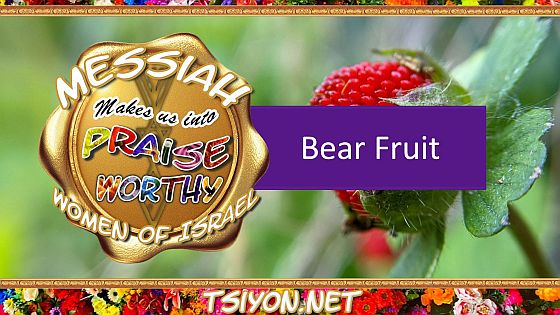
Truly bearing fruit
for the Kingdom is something we all want. Our live stream tonight is on the
simple theme: Bear Fruit. Come and join us tonight at 8 Central, at
Tsiyon.Net or other video
platforms.
Thank you, and may the Elohim of Israel root you deep in Messiah our Life,
and fill you with fruitfulness for His Kingdom.
In His Name, Eliyahu
Join our live stream
tonight! - 8 PM Central -
Tsiyon.Net
|
|
 |
|
|
|
|
|
|
|
"Let them build Me a Sanctuary, that I may reside in their midst." Ex
25:8
| |
Thanks to our Tsiyon Ministry Partners for your support of this ministry!
Not a Tsiyon Ministry Partner yet? Visit our Tsiyon
Website
for full details.
|
|
|
|
|
|
|
Leave
feedback, prayer requests and comments
here.
You may unsubscribe
here.
|
|
|
Tsiyon
9901 Brodie Lane
Suite 160, Unit 1421
Austin, TX, USA, 78748
Please make offering checks to: "Tsiyon."
|
 |
 |
 |
|
|
|
|
|
|
|