https://tsiyon.org/images/230801NL/What makes a person mighty in the Scriptures, and why you should care.

TSIYON NEWS

Tsiyon Messianic Radio Newsletter  - Vol 20.33 - 06/07/6025 TAM - 08/30/2025 AD

In this Tsiyon News...

 eliyahubendavid.substack.com/


From Eliyahu 


Among all the kings of the Kingdom of Judah, Hezekiah is listed as the best. The Scripture says of him: "He trusted in YHWH, the God of Israel; so that after him was none like him among all the kings of Judah, nor among them that were before him. For he joined with YHWH; he didn't depart from following him, but kept his commandments, which YHWH commanded Moses." (2 Kings 18:5-6)


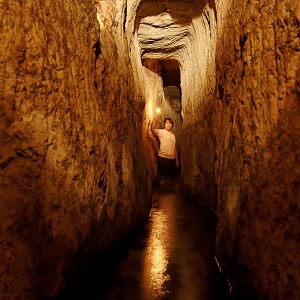
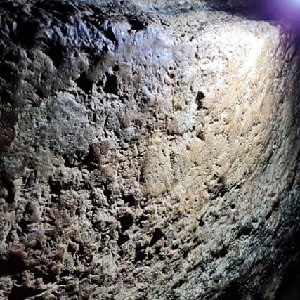
On Aug 27, 2025, last week, I presented the story of Hezekiah. Hezekiah's story is inspiring, and if you haven't seen our presentation on Hezekiah I would invite our members to see the video on our membership site Tsiyon.Net. Among other amazing achievements of Hezekiah listed in Scripture is the water project in Jerusalem including a tunnel cut out of solid rock. This tunnel continues down to this day as a testimony to the truthfulness of the Biblical account recorded in 2 Kings chapters 18-20, and other places. Even though the tunnel is obviously the one constructed by Hezekiah, there have been some who have denied that as Hezekiah's tunnel because there is no known sign posted by Hezekiah saying it is his tunnel - that is, until now. That's right, inscriptions from Hezekiah's time have been found identifying the tunnel and even explaining how it was constructed. I found an article about that, and have posted it below:

Inscription Finally Confirms Biblical Record of Hezekiah’s Tunnel


Two Israeli archaeologists have successfully deciphered an 8th century BC inscription that was left on a wall in an underground tunnel located just outside the walls of the City of David (ancient Jerusalem). The inscription references the deeds of the legendary King Hezekiah, matching certain passages from the Book of Kings and Book of Chronicles in the Hebrew Bible.


The task of deciphering the enigmatic lines, which were written in Old Hebrew script, was completed by Professor Gershon Galil, head of the Institute for Biblical Studies and Ancient History at Haifa University, and Eli Shukron from the Bible and Ancient History research institute.


According to Galil, the inscriptions include a summation of the King’s primary accomplishments during the first 17 years of his kingship, which began in the late 8th century BC and continued into the early 7th century BC. These inscriptions list Hezekiah’s accomplishments as an infrastructure builder, religious and political leader, military conqueror and accumulator of wealth.


Because of its age and contents, the inscription represents a one-of-a-kind discovery within the context of Israeli archaeology.


“These are actually the earliest manuscripts of the Bible,” Galil said in the Jerusalem Post. “They predate the Ketef Hinnom silver amulets by about 100 years and the Dead Sea Scrolls by hundreds of years. They also support the claim that scriptures in the Book of Kings are based on texts originating from chronicles and royal inscriptions, and that the Bible reflects historical reality and not imagination.”
Confirming Hezekiah’s Construction of the Siloam Tunnel


One of the events specifically referenced in the stone tablet’s inscription is the Siloam Tunnel water project, a celebrated infrastructure initiative that represents one of the most remarkable engineering feats of the ancient world.


The tunnel, which covered 1750 feet (533 meters), was designed to siphon waters from the Gihon Spring outside the walls of the City of David to the Pool of Siloam inside those walls. The construction of the tunnel was believed to have been a response to the military threat presented by the Assyrians during Hezekiah’s reign. In case the City of David were to come under siege, the tunnel would guarantee continued access to fresh water from outside the city.


The theory that King Hezekiah ordered the construction of the Siloam Tunnel water project has been widely accepted, but still considered unproven. Some academics have suggested the tunnel was actually built 100 years before the time of Hezekiah. But the newly decoded inscriptions would seem to put the issue to rest once and for all.


“Hezekiah, the son of Ahaz, king of Judah, made the pool and the conduit, in the seventeenth year, in the second (day), in the fourth (month),” the deciphered inscription says in its first two lines.


By Galil’s calculation, this means it was completed in the year 709 BC. Hezekiah is believed to have ascended to the throne in about 726 BC, so it seems he must have ordered the construction of the tunnel in the very early days of his reign.

Hezekiah's Tunnelinscription


Hezekiah’s Tunnel? The Truth is Revealed


The Gihon Spring was an underground water source located outside the walls of the ancient City of David (ancient Jerusalem). Its presence made the settlement of the City possible, and it was connected to the areas of settlement by a series of tunnels that allowed access to the spring in some cases and diversion of its water flow in others.


The story of how the Siloam Tunnel was built was revealed in 1880, when explorers in the now-dry underground aqueduct found an inscription on a wall that described the process in detail. But this inscription didn’t contain any text that would prove conclusively that it was built during the time of Hezekiah, as the Bible states in the Book of Kings and Book of Chronicles.


In 1909, another set of engravings was found on a rock wall in an access tunnel leading to the entrance of the Siloam Tunnel. But on initial examination this appeared to include only the frames used to surround inscriptions, with nothing written inside of them. The final verdict was that someone had intended to inscribe something here, but for one reason or another had never gotten around to it.


But Eli Shukron, long recognized as one of the most knowledgeable of all the archaeologists who’ve performed excavations in ancient Jerusalem, wasn’t so sure. He believed there might be faint inscriptions inside the frames that had not previously been detected, because they weren’t obvious to the naked eye. To prove his theory, Shukron recruited Gershon Galil to help him study the rock wall engravings more carefully.


“We took high-quality photos of these ‘frames,’ Professor Galil explained. “It soon became clear that there were indeed exciting and surprising texts there.”


Israeli Forensic Police Investigator Helps Solve Bible-era Mystery


Through their enterprising work, the Israeli archaeologists overturned a consensus that had held sway for more than a century.


“It turned out that there is an extremely impressive inscription there. Though eroded by time, the vast majority of the letters are legible,” Galil said. In total the newly discovered inscriptions included 11 lines of text, which the archaeologists were able to comprehend in their entirety.


Galil explained that the ancient text was divided into five sections, arranged in literary rather than chronological order. These included the title of the inscription, referencing King Hezekiah, an accounting of his construction of the Siloam water project, a brief mention of his most notable military success (“he smote the Philistines from Ekron to Gaza”), lines about his actions as a religious reformer, and finally a boast about his wealth and the wealth of his kingdom, describing how he’d accumulated “a lot of silver and gold, perfumes and good ointment” in his treasure houses.


“This is an extremely important discovery that changes [some basic assumptions of] research, since until today it was commonly accepted that the kings of Israel and Judah, unlike the kings of the ancient Middle East, did not make themselves royal inscriptions and monuments… to commemorate their achievements,” Galil said.


Even More Confirmatory Evidence Emerges


The results of this new analysis seem conclusive. But Professors Galil and Shukron have produced an additional piece of evidence linking Hezekiah with the Siloam Tunnel. This is in the form of a small rock tablet, which contains a short inscription in Old Hebrew script that the two archaeologists were able to recently decipher, after more than a decade of determined effort.


The palm-sized tablet was discovered by Eli Shukron and another colleague in a man-made pool inside the Siloam Tunnel in 2007. It was mixed in with a collection of pottery shards that were dated to the 8th century BC. The artifact contained just two lines of inscribed text, which Galil and Shukron have now translated into modern language. According to the archaeologists, this ancient writing says the following: “Hezekiah built the pool in Jerusalem.”


So in a very short period of time, the same two archaeologists have produced two separate translations of ancient writings that show King Hezekiah was indeed responsible for the construction of the Siloam water project, as most scholars have long believed.


“In these new inscriptions, there are answers to many issues that scholars have debated for years,” Professor Galil said, speaking of the results of his and Professor Shukron’s work in total. “The inscriptions are evidence that Hezekiah carried out a comprehensive reform (before 709 BC) and even that he conquered Philistia, especially Ekron, and stationed soldiers there (in 712 BC). Moreover, Hezekiah is indeed the king who built the pool and the Siloam Tunnel and not others.”


The contents of the inscriptions and the story of how they were discovered and eventually deciphered will be revealed in full in an upcoming book entitled “The Inscriptions of Hezekiah King of Judah,” which Galil and Shukron will be co-authoring.


Source:https://www.ancient-origins.net/news-history-archaeology/hezekiahs-tunnel-inscription-0017684

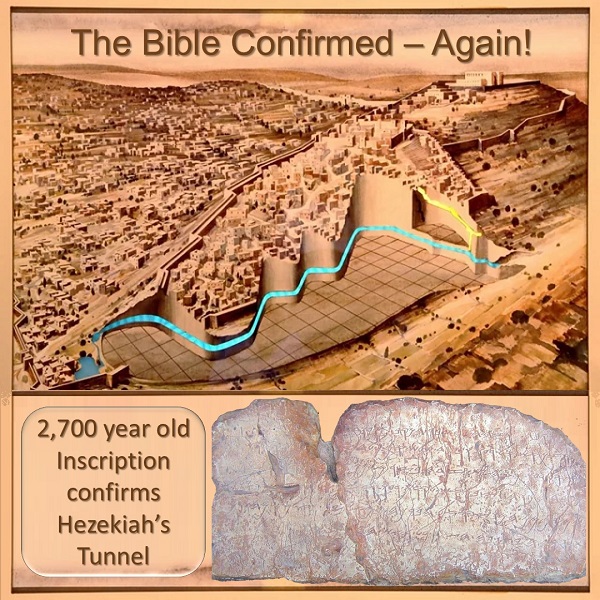
Newly identified inscriptions are at the end of Hezekiah’s tunnel. The translations read:

1. Hezekiah, the son of Ahaz, king of Judah,

2. made the pool and the conduit.

3. In the seventeenth year, in the second (day), in the fourth (month),

4. of king Hezekiah, the king brought

5. the water into the city by a tunnel, the king led

6. the water into the pool. He smote the Philistines

7. from Ekron to Gaza and placed there the OREB unit of

8. the army of Judah. He braked the images and braked in ˹pieces˺ the Nehu˹sh˺tan

9. and he removed the high ˹places and˺ cut down the Asherah. Hezek˹ia˺h, the king,

10. accumulated in all his treasure houses and in the house of YHWH

11. a lot of silver and gold, perfumes and good ointment.

Galil notes these translations read very much like biblical texts in 1 Kings 18 and 20, and goes on to suggest these 8th century BC inscriptions could be called “the earliest manuscripts of the Bible.”
 

Hezekiah's tunnel stands as a testimony through the ages of a righteous man, King Hezekiah, who heard and obeyed God, and as a result did extraordinary things that have stood the test of time. That brings me to the theme for tonight's live stream presentation: "The Righteous Hear and Obey."  Join us tonight at 8 Central, at Tsiyon.Net or other video platform, for this inspiring discussion.


In His Name, Eliyahu


Tsiyon Members - Join our live stream tonight! - 8 PM Central - Tsiyon.Net

Join us tonight!

Audio: Listen to Tsiyon RadioTsiyon Radio on TuneInSpeakerStitcher.comVideo & Audio PodcastsSpotifyGoogle Video Podcasts

Video:  FaceBookTwitterRokuYouTubePeriscopeTwitchDive.TVPodChaser

PodBeanBuzzSproutApple Video PodcastsTruthPoint Video ChannelEliyahu ben David Author Page

"Let them build Me a Sanctuary, that I may reside in their midst." Ex 25:8


Thanks to our Tsiyon Ministry Partners for your support of this ministry!
Not a Tsiyon Ministry Partner yet? Visit our Tsiyon
Website for full details.

Copyright 2025 Tsiyon

Leave feedback, prayer requests and comments here.  You may unsubscribe here.

Please help keep Tsiyon on the air! 

 Click to Donate 

Tsiyon

9901 Brodie Lane

Suite 160, Unit 1421

Austin, TX, USA, 78748


Please make offering checks to: "Tsiyon."