https://tsiyon.org/images/230801NL/What makes a person mighty in the Scriptures, and why you should care.

TSIYON NEWS

Tsiyon Messianic Radio Newsletter  - Vol 20.47 - 09/07/6025 TAM - 11/28/2025 AD

In this Tsiyon News...

 eliyahubendavid.substack.com/


From Eliyahu


Do you want to be deceived? If not, be careful about the meaning of words. Any politician, if candid, can tell you that changing the framing and meanings of important words can sway millions to accept word distortions as truth. We see that in the media all the time. Marketers and advertisers can tell you the same thing. You will likely get ads pushed at you today that use word deception to get you to buy things you don’t actually need or want. They wouldn’t be paying the big bucks for manipulative advertising if this were not the case.


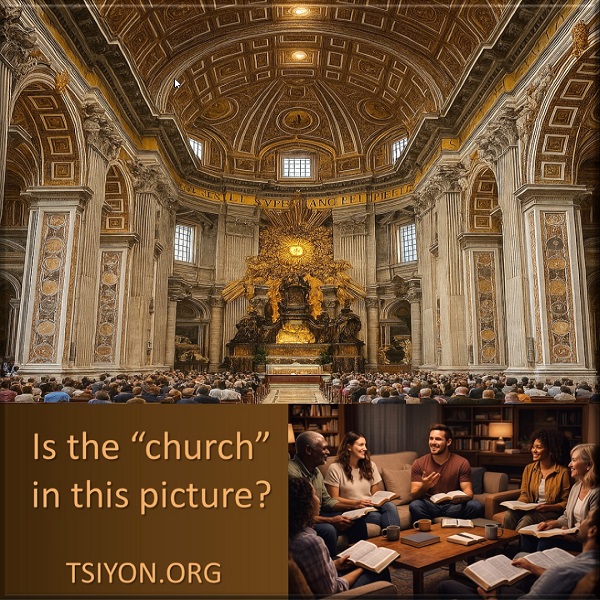
Yet, word distortion is nothing new. Religionists have used words in this way for centuries, and even millennia. As an example, let’s pick a word right out of your Bible translation that has been used to deceive generations. That word is “church.” Here is the same verse using the word “church” in two historic Bible translations:   


And I say to thee: That thou art Peter; and upon this rock I will build my church, and the gates of hell shall not prevail against it. (Matthew 16:18 Douay-Rheims Version, 1st edition released in 1582 AD)


And I say also unto thee, That thou art Peter, and upon this rock I will build my church; and the gates of hell shall not prevail against it. (Matthew 16:18 King James Version, 1st edition released in 1611 AD)


As you can plainly see, these two different translations are virtually identical. The Catholic Douay-Rheims Version pre-dated the Protestant King James Version (KJV) by 29 years, so Douay-Rheims was not copying the KJV - but could it have been the other way around? Consider this quote:


 “But while the King James translators rejected some specific translations in the Douay, they emulated others. It is commonly acknowledged that, in preparing the KJV, the translators made use of the Douay New Testament and adopted many of its readings in preference to those of other English editions. The KJV in many places thus bears a Douay “slant” absent from prior translations. Both the Douay and the KJV served as virtually the only Bible many English speakers used for centuries…” (Catholic.com)


In any event, it remains clear that the word “church” was used first by Catholic translators for the Greek word “ekklesia”. A little further on I’m going to prove to you why using the word “church” for “ekklesia” is not only a poor translation - it is, in fact, a distortion. First though, here’s a direct doctrinal statement from Vatican I (1870), which formally defined papal primacy based on Matthew 16:18:


“We therefore teach and declare that, according to the testimony of the Gospel, the primacy of jurisdiction over the whole Church of God was immediately and directly promised to the blessed Apostle Peter and conferred on him by Christ the Lord. For it was to Simon alone, to whom He had already said: ‘Thou shalt be called Cephas,’ that the Lord, after his confession, said: ‘Thou art Peter, and upon this rock I will build my Church, and the gates of hell shall not prevail against it.’” (Pastor Aeternus, Vatican Council I, 1870)


The claim is that Peter was given “jurisdiction over the whole Church.” “Jurisdiction” means “the authority of a sovereign power to govern or legislate.” This word therefore defines the “whole Church” as a religious institution to be governed - but is that the meaning of the actual Greek word “ekklesia” used in the verse? What should define the word “ekklesia” anyway?


It makes sense that the Bible then in use in the 1st century by Greek-speaking early believers should naturally define the word. What I’m saying is, they were already reading this word in their existing Bibles, so they would naturally use the word in the same way in what is called today “The New Testament” or “The Greek Scriptures”. By the first century, the LXX was THE Bible of Greek-speaking Jews and so was the most frequently used version of the then-existing Bible by the early believers.


The Greek word “ekklesia“ - commonly translated as “assembly” or “congregation” - appears prominently in the Septuagint (LXX), the Greek translation of the Hebrew Scriptures produced between the 3rd and 2nd centuries BC. As noted above, this is the Bible used by Greek-speaking Jews and other believers. In this translation, “ekklesia” is used 77 times, most often to render the Hebrew word “qahal”, which denotes the gathered people of Israel before God. This consistent usage demonstrates that the concept of “ekklesia” was firmly rooted in the idea of the covenant community of Israel, not a building or institution.

 

assemblyekklesia


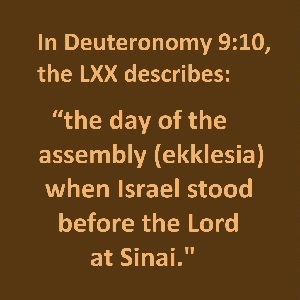
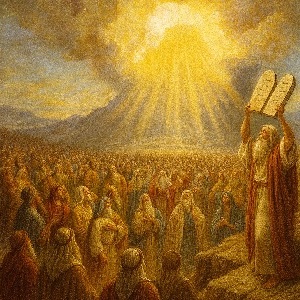
In passages such as Deuteronomy 9:10, the LXX describes “the day of the assembly (ekklesia) when Israel stood before the Lord at Sinai." Similarly, Deuteronomy 31:30 records Moses speaking “in the ears of all the assembly (ekklesia) of Israel.” These examples show that “ekklesia” was used to describe the collective gathering of God’s people of Israel in moments of worship, covenant renewal, and national identity.


The word also appears in historical contexts. In Judges 20:2, the tribes of Israel gather “in the assembly (ekklesia) of the people of God” to deliberate over justice. Here, “ekklesia” conveys communal decision-making. This reinforces the idea that the assembly was both spiritual and civic, encompassing the whole life of Israel as God’s people.


The significance of this usage is profound. When the New Testament writers adopted “ekklesia” to describe the gatherings of believers in Messiah, they were drawing directly on this Scriptural background. The “ekklesia” was not a physical structure but the community of God’s covenant people Israel, now reconstituted around the Messiah as the renewed Israel. When Messiah said “I will build my assembly (ekklesia)” it is renewed Israel that He is talking about. When Gentiles believed in Messiah they were grafted-in to this renewed Israel - not some new Gentile religious organization. (Romans 11:24)


This continuity explains why Paul and other apostles used “ekklesia” to describe local congregations and the universal body of believers, echoing the assembly of Israel in the wilderness and in the land.

Later translation choices, particularly in English, obscured this meaning.


The rendering of “ekklesia” as “church” shifted the emphasis toward buildings and institutions, rather than the Assembly of Israel. By the 4th century, Gentile Christianity had become the religion of empire under Constantine. The emphasis shifted from small gatherings of believers to grand basilicas and hierarchical structures. As shown above, The English word “church” does not derive from “ekklesia” - it is from the Greek “kyriakē” (“the Lord’s house”), which referred to a building. Thus, the linguistic shift itself reflects a move from people-centered assemblies to building-centered institutions.


This change was not accidental. Scholars like Larry Overton argue that the adoption of “church “ was a deliberate mistranslation: “So how did the transliteration/mistranslation church come to be the accepted rendering in English? The short answer is… the Church!” In other words, ecclesiastical authorities preferred a term that reinforced their institutional power rather than the grassroots assemblies implied by “ekklesia.”


In English Bible history, this tension is clear. William Tyndale’s translation (1526) rendered “ekklesia” as “congregation” to emphasize the community of believers. But this was controversial, as it undermined the authority of the established church. King James’ 1604 translation rules explicitly required: “The old ecclesiastical words to be kept, as the word ‘Church’ not to be translated ‘Congregation.” This directive ensured that the King James Version reinforced hierarchical church structures. The choice was political more than linguistic.


The result is that modern Bibles often perpetuate this institutional emphasis. The United Church of God summarizes:

“Church is the English translation of the Greek word ekklesia… but the English word church itself came to mean a religious building or institution, not the assembly of believers”.

This demonstrates how translation choices of words continue to shape theology and practice, often in ways that obscure and distort the original meaning of Scripture.


The translation of “ekklesia” as “church” created and represents a historical shift from assemblies of believers to institutional authority. From Constantine’s basilicas to King James’ directives, the word “church” has been used to reinforce hierarchy and control over man-made institutions. Establishing this with historical fact shows that the change was not neutral but self-serving, and its effects remain embedded in modern translations.


None of this undermines the Scriptures in their original form. All of this is a testimony to the need for due diligence in personally digging deeper beyond the surface in one’s Bible study. Do not be dismayed by this. He has sent us another Helper, the Holy Spirit, to guide us into all truth - if only we make it our priority to search for it. (Jn 14:16, Matt 7:7-11)


Messiah's Mighty Men will be digging deeper in their live discussion tonight. Their theme will be: Keeping the Covenant Through Perpetuity. I like that title. As we've seen above, things tend to get distorted over time. Dealing with that in perpetuity is definitely worth digging into. That's tonight at 8 Central, at Tsiyon.Net and other video platforms. It's good food - come and get it!


In His Name. Eliyahu    


Contact:   https://tsiyon.org  -  https://eliyahubendavid.substack.com/


Join us tonight at Tsiyon.Net for this encouraging group discussion!

Come join us!

Audio: Listen to Tsiyon RadioTsiyon Radio on TuneInSpeakerStitcher.comSpotifyGoogle Video Podcasts

Video:  FaceBookTwitterRokuYouTubePeriscopeTwitchDive.TVPodChaser

PodBeanBuzzSproutApple Video PodcastsTruthPoint Video ChannelEliyahu ben David Author Page

"Let them build Me a Sanctuary, that I may reside in their midst." Ex 25:8


Thanks to our Tsiyon Ministry Partners for your support of this ministry!
Not a Tsiyon Ministry Partner yet? Visit our Tsiyon
Website for full details.

Copyright 2025 Tsiyon

Leave feedback, prayer requests and comments here.  You may unsubscribe here.

Please help keep Tsiyon on the air! 

 Click to Donate 

Tsiyon

9901 Brodie Lane

Suite 160, Unit 1421

Austin, TX, USA, 78748


Please make offering checks to: "Tsiyon."