https://tsiyon.org/images/230801NL/What makes a person mighty in the Scriptures, and why you should care.

TSIYON NEWS

Tsiyon Messianic Radio Newsletter  - Vol 20.50 - 09/28/6025 TAM - 12/19/2025 AD

In this Tsiyon News...

 eliyahubendavid.substack.com/


From Eliyahu


 Most believers know Babylon from kid’s Bible stories: the fiery furnace, the lion’s den, the handwriting on the wall.

They may remember names like Nebuchadnezzar and Belshazzar, but usually think of them as the “bad guys” in the story of Daniel and his friends.

What we may not always realize is this: the Neo-Babylonian Empire (the Babylon of Daniel, Ezekiel, and Jeremiah) changed the world in ways that still touch our lives today.

It only lasted less than a century - from the rise of Nabopolassar and Nebuchadnezzar to the night when Cyrus’ troops walked into Babylon under Belshazzar. In Bible terms that’s just a couple of chapters! And yet, like the empire of Alexander centuries later, that short period was a hinge in history.

Let’s walk through some of the ways YHWH used that moment to reshape the world - and our faith - “for all time.”

First, a bit of orientation. Before Babylon rose, Assyria had dominated the region for about 300 years. Assyria’s capital was Nineveh - the same city Jonah was sent to. Assyria crushed the ten tribe northern kingdom of Israel and scattered the ten tribes to the four winds.

Then, toward the end of the 600s BC, Assyria began to crumble. A Babylonian leader named Nabopolassar rebelled, allied himself with the Medes, and together they destroyed Nineveh. The Assyrians were not done though. They established Harran as the new capital of Assyria after that. Babylon attacked. With the fall of Harran in 609 BC the Assyrian empire ceased to exist, and Babylon had won all that had been Assyria’s before. Nebuchadnezzar II took over and built Babylon into the superpower we meet in Scripture.

So when you read about: Jerusalem’s fall, the destruction of the Temple, the deportation of Daniel and Ezekiel, you’re standing right in the middle of this Neo-Babylonian moment.

It felt, at the time, like the end of the world for Judah. In a sense, it was. But it was also the beginning of something YHWH was doing that reached far beyond that generation.

Nebuchadnezzar didn’t simply conquer Judah. He reshaped the whole map of the region. He controlled the lands from the Persian Gulf up through Mesopotamia, over through Syria, and down toward Egypt. Trade routes, armies, and tribute streams all flowed through Babylon.

For Judah, this meant:

- Termination of the Davidic throne in Jerusalem - for a time.

- The destruction of Solomon’s Temple.

- The exile of the king, the priests, the craftsmen, and the educated classes to Babylon i.e. the end of Judah as a functional society.

Babylon is where Daniel, Ezekiel, and many others then lived and served. The people of YHWH were no longer safely tucked away in their own land. They were scattered into the heart of a pagan empire. That sounds like pure tragedy.

Yet YHWH was doing more than judging; He was also repositioning His people. Before ever Israel became a nation YHWH had said “all the nations of the earth will be blessed in Abraham”. YHWH had a bigger picture in mind for Israel - a picture that involves all nations. (Genesis 18:18)

 Think about it:

- Faithful Israelites now lived in the crossroads of the ancient world.

- They carried with them the Scriptures they already had, and the prophets continued to speak.

- The knowledge of YHWH was planted right inside the empire that ruled the nations.

Babylon thought it was just moving prisoners around. YHWH was planting seeds that would bring forth fruit to eternal life.

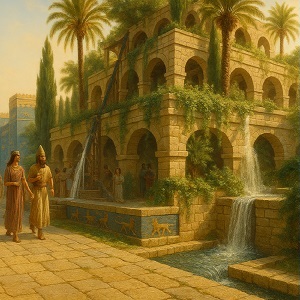
Of course, none of that is what Babylon thought they were doing: Nebuchadnezzar poured enormous wealth into turning Babylon into the showpiece of his power - the pinnacle of human glory. Ancient descriptions (and modern excavations) talk about the glorious building projects of Babylon. In other words, Babylon was built as a visual sermon about human greatness. The message was: “Look at this city and see the glory of our gods - and of our king.”

Now read Daniel with that in mind:

- The golden statue on the plain of Dura

- Nebuchadnezzar walking on the roof of his palace saying, “Is not this great Babylon that I have built… by the might of my power and for the glory of my majesty?”

- The handwriting on the wall during Belshazzar’s blasphemous feast.

 Babylon is not just a place; it becomes the symbol of human pride dressed up in religious clothing. The city is the perfect stage for YHWH to demonstrate that He alone is King, and that empires, however glorious, are temporary.


SplendorBabylon


That symbol stuck. Long after the bricks of Babylon crumbled, the Bible still uses “Babylon” as a picture of arrogant, idolatrous world-systems (especially in Revelation). When we speak of “Babylon the Great” falling, we’re drawing on imagery born in this Neo-Babylonian period.


That is not to say Babylon was only about human pride. They also made achievements that were building blocks upon which modern science eventually arose. For example, the Babylonians were careful observers of the heavens. For centuries they meticulously recorded movements of the moon and planets, and unusual celestial events.

They developed a sophisticated system of mathematics, using base-60 (that’s why we have 60 minutes in an hour and 360 degrees in a circle). Over time they learned to predict certain heavenly events with surprising accuracy.


Why does that matter?


Because later Greek astronomers borrowed heavily from Babylonian records and methods, and so on after them. That Babylonian data eventually flowed into astronomy and other sciences, right down into the way we tell time and measure space today. In His sovereignty, YHWH can take even the intellectual pursuits of a pagan empire and weave them into the larger story of human knowledge, and has done so for His purposes.


From Judah’s point of view, the Babylonian conquest was the darkest moment in their national story.

- The Temple burned.

- The walls were torn down.

- The king was captured.

- The people were marched away in chains.

If the story ended there, we would expect the faith of Israel to dissolve into despair. But that’s not exactly what happened.

Instead, something deep changed in the people of YHWH during the exile. Without a Temple, sacrifices, or a Davidic king, the exiles had to ask: “Who are we now? How do we remain YHWH’s people in a foreign land?”


In that context, the Torah and the words of the prophets took on a new, central importance. The community gathered around the Scriptures, around prayer, and around obedience in daily life.

The seeds of later synagogue life, rabbinic teaching, and Torah study as a way of life were planted in Babylon. Judaism did not die in exile; it matured, and then later morphed into something other than the ancient Israelite worship as perceived by Moses.


The Jewish community in Babylon continued to be hugely influential in Judaism for centuries. Already in the Persian period, returning exiles brought back Babylonian month names - Nisan, Iyyar, Tammuz, Elul, Tishri, Adar, etc. - which are still used today.


After the Temple’s destruction by the Romans in 70 AD, the Jewish calendar gradually shifted from being set by eyewitnesses in Jerusalem to being calculated in advance. This was a huge shift away from the calendar system handed down by Moses.


Tradition attributes that decisive adoption of a calculated calendar to Hillel II in the mid-fourth century AD. But the Jewish calendar in use today was developed over several centuries, largely under the leadership of Babylonian academies and exilarchs. In that sense, Babylon did not only shape Jewish space (exile); it also re-shaped Jewish time itself.


The influence of Babylon on Judaism has been great indeed, but the same can be said of Babylon’s influence on the Christian Church … a subject for another time. The point is: Babylon is still with us in science, culture and religion, making Babylon far more important for believers to understand than merely a handful of Bible stories.


So when you next read about Nebuchadnezzar, or see the word “Babylon” in your Bible, remember: this is not just an old story. It’s one of the great turning points in the history of the world, and in the story of God’s people.


And the same God who ruled over Babylon still rules over every “empire” today - political, cultural, or personal. The kingdoms of this world rise and fall, but “YHWH is King forever and ever.” (Ps 10:16)


All of this I have just written is to accomplish one goal: to wet your appetite to come and take in tonight's Babylon Triple Header! All of this is of great interest of its own. However, its bigger than that.


What I'm sharing with our Tsiyon Members in this Remnant RoundUp will give you the foundation required as we move on from here to unlock amazing prophecies of Scripture that have never before been understood. This is only for our Tsiyon Members, tonight at 8 Central, at Tsiyon.Net - and no other video platforms. I intend to take you on a ride of Scripture understanding like you have never experienced before!   


In His Name. Eliyahu    


Contact:   https://tsiyon.org  -  https://eliyahubendavid.substack.com/


Join us tonight at Tsiyon.Net for this encouraging group discussion!

Come join us!

Audio: Listen to Tsiyon RadioTsiyon Radio on TuneInSpeakerStitcher.comSpotifyGoogle Video Podcasts

Video:  FaceBookTwitterRokuYouTubePeriscopeTwitchDive.TVPodChaser

PodBeanBuzzSproutApple Video PodcastsTruthPoint Video ChannelEliyahu ben David Author Page

"Let them build Me a Sanctuary, that I may reside in their midst." Ex 25:8


Thanks to our Tsiyon Ministry Partners for your support of this ministry!
Not a Tsiyon Ministry Partner yet? Visit our Tsiyon
Website for full details.

Copyright 2025 Tsiyon

Leave feedback, prayer requests and comments here.  You may unsubscribe here.

Please help keep Tsiyon on the air! 

 Click to Donate 

Tsiyon

9901 Brodie Lane

Suite 160, Unit 1421

Austin, TX, USA, 78748


Please make offering checks to: "Tsiyon."