https://tsiyon.org/images/230801NL/What makes a person mighty in the Scriptures, and why you should care.

TSIYON NEWS

Tsiyon Messianic Radio Newsletter  - Vol 21.01 - 10/14/6025 TAM - 01/03/2026 AD

In this Tsiyon News...

 eliyahubendavid.substack.com/


From Eliyahu


I have been thinking a great deal lately about the power of speech, and more specifically about how Scripture frames the moral weight of what we say about one another.

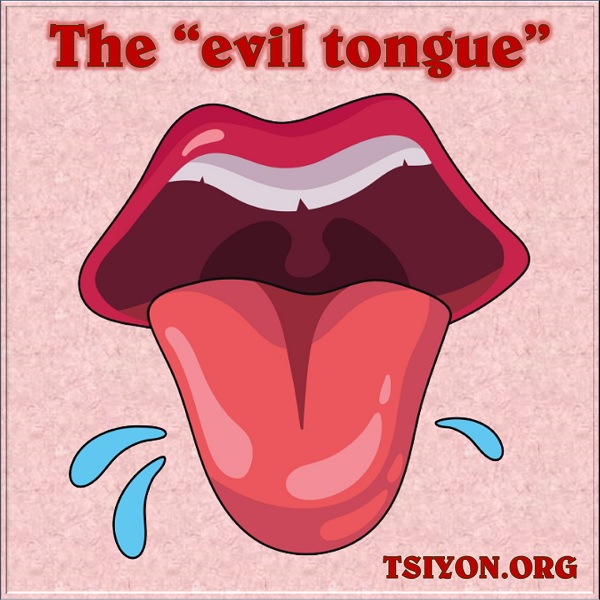
It is striking how often damage within any covenant community does not come from open hostility, but from words spoken casually, repeatedly, and often with the confidence that they are “true.” The Hebrew Scriptures give this problem a name: lashon hara - the “evil tongue.”

What makes lashon hara so dangerous is that it does not require deception. It can consist entirely of accurate statements. The issue is not truthfulness, but authorization. Who has the right to speak? To whom? For what purpose?

In the Torah, speech is never morally neutral. Words can either guard life or quietly undermine it. Yeshua manifested this Torah mindset when He said:

"I tell you that every idle word that men speak, they will give account of it in the day of judgment. For by your words you will be justified, and by your words you will be condemned." (Matt 12:36-37)

Perhaps the clearest commandment on this subject of lashon hara appears in Leviticus 19, a passage devoted to holiness as it is lived out in ordinary relationships. The Torah says,

“You shall not go up and down as a talebearer among your people.”

That phrase - talebearer - is important. It does not describe someone who lies, but someone who carries information from place to place. The command continues by forbidding hatred hidden in the heart, requiring direct rebuke when sin is present, and concluding with the well-known charge to love one’s neighbor as oneself.

All of these ideas are bound together. The Torah does not merely prohibit harmful speech; it prescribes a righteous alternative.

What stands out to me is that the commandment assumes something very realistic about human nature. If we do not speak directly to the one with whom we have a grievance, the unresolved matter will not simply disappear. It will find another outlet. Often that outlet is conversation with a third party - conversation that feels justified because it is factual, but which quietly violates the Torah’s command. Lashon hara is frequently the result of obedience deferred.

This helps explain why the Torah places the instruction “you shall surely rebuke your neighbor” right alongside the prohibition of talebearing. Rebuke is not cruelty; it is covenant responsibility. To speak about a brother rather than to him is often a way of avoiding the discomfort of righteousness while still releasing the pressure of resentment. The Torah refuses to allow that escape.

When we turn to the apostolic writings, it becomes clear that this ethic did not change. Paul, who was trained in Torah and lived within its moral framework, warns Timothy about believers who move from house to house, not only idle, but gossips and busybodies, speaking things they ought not. He does not describe this as a minor social flaw. He treats it as a spiritual disorder that corrodes the health of the community. Once again, the problem is not that what is being said is false, but that it is not meant to be said in that way, to that audience.

This is one of many places where the so-called divide between “Old Testament” and “New Testament” dissolves upon closer inspection. What Paul is addressing is not a new sin created by a new religion, but a well-known Torah violation manifesting in the assembly.

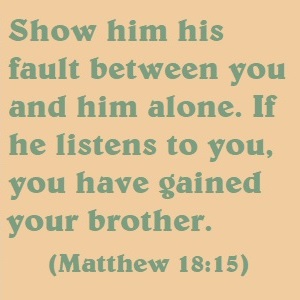
No one demonstrates this continuity more clearly than Yeshua Himself. When He teaches about how to handle sin between brothers, He does not abolish Leviticus 19 - He brings it into sharper focus in Matthew 18.

He instructs that if a brother sins, the first step is private conversation. Not public exposure. Not indirect discussion. Not a request for prayer framed as concern. A direct appeal, between two people, with the explicit goal of restoration.

Only if that fails does Yeshua permit the involvement of others, and even then, the expansion is measured and purposeful. Witnesses are added, not to amplify shame, but to establish truth and to guard against injustice. Only after every opportunity for quiet resolution has been exhausted does the matter come before the assembly. At no point does Yeshua authorize the free circulation of damaging information.

one to oneconflict resolved


What is especially striking is that He follows this instruction immediately with His teaching on binding and loosing. This is often treated as a statement about ecclesiastical authority, but in context it is something far more grounded. Yeshua is explaining that when the community faithfully applies God’s commands - commands already given in the Torah - heaven stands in agreement. The authority does not come from the community inventing rules, but from the community submitting itself to divine instruction.

In other words, when the Torah’s wisdom regarding speech, rebuke, and restraint is practiced faithfully, God Himself stands behind the outcome. Righteous process invites divine agreement. This is righteous order.

All of this raises uncomfortable questions for us today. How often do we speak because we are correct, rather than because we are called? How often do we justify conversation that Scripture would forbid simply because it feels necessary, or even helpful? And how often do we confuse concern with permission?

Lashon hara thrives in environments where accountability is diffused and responsibility is shared vaguely. It diminishes in communities where brothers love one another enough to speak directly, patiently, and privately. The Torah assumes that righteousness will sometimes be uncomfortable. It also assumes that peace purchased at the expense of obedience is not peace at all.

I am increasingly convinced that much of what we call “conflict” in the body could be avoided entirely if Leviticus 19 and Matthew 18 were taken seriously - not as ideals, but as instructions. Words would be fewer. Trust would be stronger. Restoration would be more common. And silence, when required, would be understood as obedience rather than avoidance.

The command to love one’s neighbor as oneself has never been sentimental. It has always been practical, disciplined, and demanding. It governs not only what we do, but what we say, and just as importantly, what we choose not to say.

YHWH has always desired a people who reflect His holiness not only in doctrine, but in speech, restraint, and love for one another. If every believer applied Leviticus 19 and Matthew 18 faithfully, entire categories of conflict would disappear. Communities would be safer. Reconciliation would be possible. And the tongue - so often a weapon - would become an instrument of peace.

May YHWH teach us to guard our tongues not out of fear, but out of covenant faithfulness. And may our words, spoken at the right time and in the right way, become instruments of life rather than quiet agents of harm.

“You shall love your neighbor as yourself. I am YHWH.” (Lev 19:18)

That command has never been revoked.

We invite you to join us for our next live stream, tonight, to take in a thoughtful discussion of Matthew 18. That's tonight at 8 Central, at Tsiyon.Net - and other popular video platforms. Discussions like this help us bring more peace and happiness into our lives.
 

In His Name, Eliyahu    


Contact:   https://tsiyon.org  -  https://eliyahubendavid.substack.com/


Join us tonight at Tsiyon.Net for this encouraging group discussion!

Come join us!

Audio: Listen to Tsiyon RadioTsiyon Radio on TuneInSpeakerStitcher.comSpotifyGoogle Video Podcasts

Video:  FaceBookTwitterRokuYouTubePeriscopeTwitchDive.TVPodChaser

PodBeanBuzzSproutApple Video PodcastsTruthPoint Video ChannelEliyahu ben David Author Page

"Let them build Me a Sanctuary, that I may reside in their midst." Ex 25:8


Thanks to our Tsiyon Ministry Partners for your support of this ministry!
Not a Tsiyon Ministry Partner yet? Visit our Tsiyon
Website for full details.

Copyright 2025 Tsiyon

Leave feedback, prayer requests and comments here.  You may unsubscribe here.

Please help keep Tsiyon on the air! 

 Click to Donate 

Tsiyon

9901 Brodie Lane

Suite 160, Unit 1421

Austin, TX, USA, 78748


Please make offering checks to: "Tsiyon."