https://tsiyon.org/images/230801NL/What makes a person mighty in the Scriptures, and why you should care.

TSIYON NEWS

Tsiyon Messianic Radio Newsletter  - Vol 21.03 - 10/28/6025 TAM - 01/17/2026 AD

In this Tsiyon News...

 eliyahubendavid.substack.com/


From Eliyahu


I’ve been thinking lately about something most people rarely stop to consider. We wake up, go to work, pay bills, raise our children, deal with the news, plan for the future - and we do all of this inside a world whose “normal” feels self-evident. But what if the world we take for granted is not self-evident at all? What if it is the product of a long chain of human choices and divine interventions stretching back thousands of years? And what if the Bible - because it spans millennia and follows the same covenant story through generations - preserves some of the most world-shaping turning points humanity has ever known?

Indeed, the people and events reported in Scripture helped form the very categories by which later civilizations learned to think - about God, law, justice, kingship, sin, mercy, human dignity, hope, and the meaning of history itself. Even those who do not believe the Bible live downstream from the world it helped build. To illustrate this, I want to walk through five biblical personalities - one at a time, linked together like stones in a path. Each one adds something essential, and each prepares the way for the next. And yes, this story builds toward Yeshua, because no figure has changed the world more - yet He does not arrive as a detached spiritual guru, but as the culmination of a long covenant trajectory.

Let’s begin where the story itself insists we begin: with Abraham.

Abraham does not enter Scripture as a philosopher with a system. He enters as a man called by God. The significance of Abraham is not first what he did, but what YHWH promised to do through him. In a world of random tribes and local gods, Abraham becomes the starting point of a different kind of identity - one grounded in covenant. This is where the notion of a people set apart begins to take shape, not as a badge of superiority, but as a vessel of purpose. The promise given to Abraham holds together two truths that the world still wrestles with: God is personal and sovereign, and history is going somewhere.

YHWH moves within history and makes promises that reach beyond one man’s lifespan. When people today speak as though faith is a private matter, disconnected from the world, they are speaking a language Abraham’s story does not support. The Abrahamic covenant is not a retreat from history. It is the beginning of a Divine reordering of history. But a promise alone is not enough to form a people. A people must be shaped, disciplined, and taught how to live. That brings us to Moses.

If Abraham is the man of covenant promise, Moses is the man of covenant formation. Through Moses, the descendants of Abraham are not merely a family; they become a nation. And they do not become a nation in the ordinary way - by conquering territory first and then writing laws later. Israel becomes a nation by redemption, by being brought out, and then by receiving instruction. The Torah is not merely an ethical code. It is a covenant constitution. Through Moses, we see that YHWH does not merely rescue from slavery; He establishes a way of life.

This has enormous implications for the world we live in now. Many of the moral assumptions people inherit - often without realizing where they came from - flow from this worldview: that justice is not merely what the powerful can enforce; that human life has value because it is accountable to God; that the poor, the widow, and the stranger matter; that rulers and citizens alike stand under divine standards. Moses introduces a moral order in which God’s holiness is not abstract, but practical - expressed in how people treat one another, how courts function, how power is restrained, and how community is preserved.

And Moses also intensifies the tension. If Israel is called to be distinct, then the question becomes: will they embrace that distinctness, or will they resent it? Will they live as a nation under YHWH’s kingship, or will they chase the same visible structures that the surrounding nations trust? That unresolved tension leads directly to the monarchy and to David.

David is one of the most complicated gifts in the Bible’s story. On the one hand, David represents the consolidation of Israel as a kingdom and the establishment of a royal line. On the other hand, David also embodies the very tension Israel struggled with from the beginning: the desire for a human king like the nations, set against the reality that YHWH alone is King. David matters historically because he becomes the anchor for Israel’s hope of righteous rule. He is the pattern against which later kings are measured. He becomes the root of messianic expectation: the promise that one day, a king will arise who will rule forever in justice and faithfulness.

Yet David’s story also makes something painfully clear. Even the best king is still a man. Even the most gifted ruler is still vulnerable to sin.

The ProblemSin


David’s sin is not hidden; it is written for all generations to see. That honesty is itself world-shaping. It tells us the Bible does not build hope on idealized heroes. It builds hope on YHWH’s faithfulness in the face of human weakness.

And once kingship enters the picture, the stakes rise. Kings can protect justice - or institutionalize injustice. They can shepherd - or exploit. By the time you read the prophets, you can feel that tension reaching a breaking point.

Eventually the system collapses, and exile becomes inevitable. Israel’s purpose is to represent YHWH in the world. If “being like the nations” becomes the value, then the nation is moving against its very calling - and the end must be disaster. So where does hope come from once the nation has failed, once kingship has been overturned, and once the people have been scattered? That question brings us to the apostles.

When people hear the word “apostles,” they often think only of early church history. But biblically, the apostles stand in continuity with everything that came before. They are witnesses of Yeshua, yes - but that witness is not a break from Israel’s story. It is the announcement that Israel’s hope has reached its turning point. Their message is not “forget the Torah and start something new.” Their message is that the New Covenant promised by the prophets has arrived, and that the nations are being brought near - not as outsiders forming a new religion, but as people being drawn into YHWH’s covenant purposes. (Jer 31)

This is where Paul’s explanation in Romans 11 is so important: Gentiles grafted into the cultivated olive tree. That story is not a picture of replacement. It is a picture of enlargement and restoration. The root remains. The covenant story remains. The God of Israel remains. And yet the mercy of YHWH reaches outward, gathering people from the nations to share in what He promised long ago. In that sense, the apostles changed the world by carrying Israel’s covenant story into the Gentile world - not as a cultural export, but as a divine invitation. They taught the nations to read Israel’s Scriptures as living truth and to see history as something YHWH governs toward an appointed end.

Which finally brings us to Yeshua Himself.

It is impossible to overstate the world-changing impact of Yeshua. Yet one of the most important things to say about Him - especially for those of us who care about the Hebraic foundations of our faith - is that Yeshua does not arrive as a detached spiritual figure floating above history. He arrives as the fulfillment of everything we have traced. He is the answer to Abraham’s promise, the embodiment of Moses’ covenant vision, the rightful heir to David’s hope, and the center of the apostolic witness.

And how did He change the world? Not merely by inspiring private spirituality, but by announcing the Kingdom of God and demonstrating what it looks like when YHWH’s reign touches human life. He taught mercy with moral gravity. He taught forgiveness without denying justice. He called people back to the heart of the Torah rather than away from it. He confronted hypocrisy, exposed false religion, and invited sinners into repentance and restoration. He spoke of a covenant not written on stone alone but written on hearts - exactly what Jeremiah foretold. He did not make Israel’s calling irrelevant; He made it possible to achieve.

The world we live in - its moral vocabulary, its sense that history matters, its conviction (even when inconsistently applied) that power should be accountable to righteousness - has been shaped profoundly by the ripple effects of this story. Even modern secular ideals often borrow their emotional force from categories the Bible introduced: dignity, justice, moral accountability, compassion for the weak, and hope that evil is not ultimate. People may argue about theology, but they still live in a world that has been deeply influenced by the Bible’s overarching picture. And this is all without even considering the world to come – where all this will take us.

YHWH has truly guided history through covenant and promise, and our lives are not drifting through random events. We are living inside a Divine story in which we all get to write our own personal chapter.

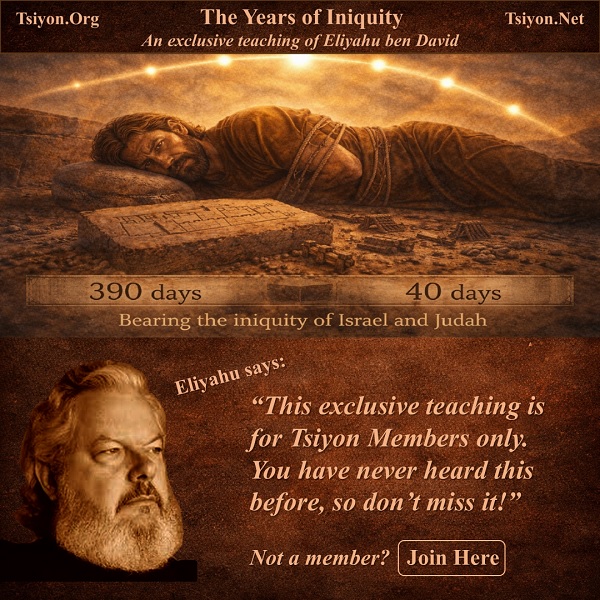
This brings me to my special Remnant Roundup presentation tonight, prepared with love and care for you, our Tsiyon Members. My theme will be: The Years of Iniquity.

This will be a historic presentation in two ways. It is about a mystery that has never before been unraveled, and this will be fully revealed tonight. It is not too much to say, in that sense, it will be a history-making presentation that you can be a part of. This presentation is also historic in that it unravels a part of the Bible’s historical story that overlaps with secular history in an amazing way that reveals amazing things about our God. In my opinion, it is a jaw-dropper for sure.

Not only will you get this special presentation, but we have created some other special features for you. How about some original music highlighting our theme? If you show up 15 minutes early you will be treated to a special musical program of original Tsiyon music, with more at the end of the program - and other special features as well.   

This special program will be streamed only from our Tsiyon membership site at Tsiyon.Net. We invite you to join us for that live stream program, tonight at 8 Central, at Tsiyon.Net - with the special musical program starting 15 minutes earlier at 7:45 Central. I'm looking forward to sharing all of this with you.

In His Name, Eliyahu

PS - Why not log in earlier today to be sure you don't have any technical problems logging in? That way you can be sure not to miss any of this.


Contact:   https://tsiyon.org  -  https://eliyahubendavid.substack.com/


Join us tonight at Tsiyon.Net exclusive presentation!

Sign Up

Audio: Listen to Tsiyon RadioTsiyon Radio on TuneInSpeakerStitcher.comSpotifyGoogle Video Podcasts

Video:  FaceBookTwitterRokuYouTubePeriscopeTwitchDive.TVPodChaser

PodBeanBuzzSproutApple Video PodcastsTruthPoint Video ChannelEliyahu ben David Author Page

"Let them build Me a Sanctuary, that I may reside in their midst." Ex 25:8


Thanks to our Tsiyon Ministry Partners for your support of this ministry!
Not a Tsiyon Ministry Partner yet? Visit our Tsiyon
Website for full details.

Copyright 2025 Tsiyon

Leave feedback, prayer requests and comments here.  You may unsubscribe here.

Please help keep Tsiyon on the air! 

 Click to Donate 

Tsiyon

9901 Brodie Lane

Suite 160, Unit 1421

Austin, TX, USA, 78748


Please make offering checks to: "Tsiyon."