https://tsiyon.org/images/230801NL/What makes a person mighty in the Scriptures, and why you should care.

TSIYON NEWS

Tsiyon Messianic Radio Newsletter  - Vol 21.06 - 11/21/6025 TAM - 02/09/2026 AD

In this Tsiyon News...

 eliyahubendavid.substack.com/


From Eliyahu


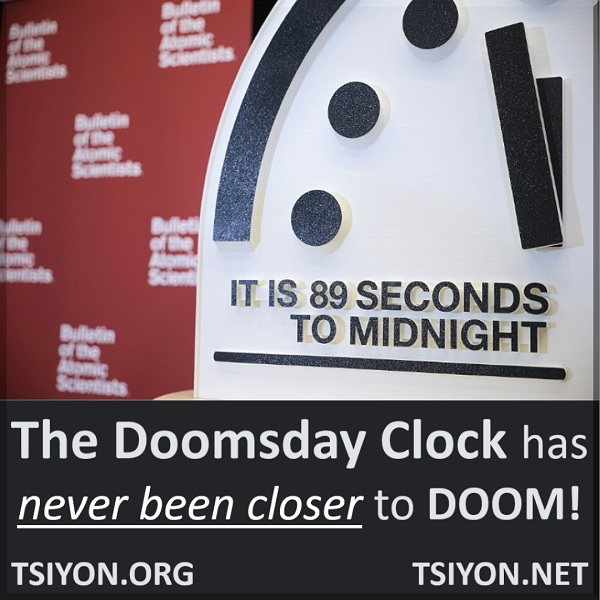
In January of 2026, the scientists who oversee the Doomsday Clock announced that the world is closer to midnight than at any point since the clock was first introduced in 1947. This announcement passed quickly through the news cycle for many people. A headline, a number, a brief sense of unease - and then life went on. But the fact that the clock has been moved closer to midnight than ever before should give us pause. Not because scientists are prophets, but because they are observers of trends - political, technological, military, and environmental - that increasingly converge toward instability.


For those who take history seriously, and for those who read the Bible with open eyes, the movement of the Doomsday Clock invites a deeper reflection. Not simply on how close we are to danger, but on why the world seems unable to step back from it. First though, a few words about the Doomsday Clock itself.


The Doomsday Clock is maintained by the Bulletin of the Atomic Scientists, a group founded by scientists who worked on the Manhattan Project. After witnessing firsthand the destructive power of nuclear weapons, they sought a way to communicate existential risk to the public in a simple, visual form.


The clock is symbolic. It does not measure time in the ordinary sense. Instead, it measures how close humanity is to self-destruction, based on expert assessment of global threats. When risks increase, the minute hand moves closer to midnight. When risks recede, it moves back.


Over the decades, the clock has reflected the Cold War, nuclear arms treaties, regional conflicts, climate change, cyber warfare, biological risks, and the rise of destabilizing technologies. It has moved both backward and forward at different points in history. But never before has it stood this close to midnight.


In 2026, the Bulletin announced that the clock had been moved forward again, placing humanity nearer to catastrophe than at any previous moment. The decision was not based on a single crisis, but on the convergence of multiple, reinforcing dangers.


What makes this moment unique is not merely the presence of threats - human history has always been dangerous - but the way those threats now interact. Nuclear tension, technological acceleration, environmental strain, political fragmentation, and erosion of trust are no longer isolated problems. They amplify one another.


In short, the world is not simply facing many risks. It is facing a system of risks that feed on instability itself.


Nuclear weapons remain the central concern of the Doomsday Clock, just as they were in 1947. While the Cold War ended decades ago, the nuclear danger never truly disappeared. Instead, it evolved.

Today, nuclear arms control agreements have weakened or collapsed. Communication between nuclear-armed states has become more strained. Modernization programs are expanding arsenals rather than reducing them. And regional conflicts now carry the potential to draw in nuclear powers more easily than before.


What is particularly concerning is not only the existence of these weapons, but the shortened decision-making timelines associated with them. Advanced warning systems, hypersonic delivery platforms, and automated command technologies compress the window for human judgment. In a crisis, leaders may have minutes - or seconds - to decide the fate of millions.


The biblical prophets often warned about violence multiplying because restraint was removed. The danger today is not merely malicious intent, but a world structured for speed, retaliation, and escalation.


"Climate change" is another major factor cited in the 2026 adjustment. Extreme weather events, water scarcity, and ecosystem collapse are no longer distant projections. They are present realities.


Environmental stress does not remain environmental. It becomes political, economic, and social. Crop failures lead to unrest. Water shortages intensify conflict. Displacement strains borders and fuels resentment. Governments already under pressure are pushed closer to failure.


Scripture frequently links environmental collapse with human moral failure - not as a mechanical punishment, but as the natural consequence of exploitation and injustice. The land “mourns,” the prophets say, because those who dwell upon it do not walk rightly.


In that sense, environmental crisis is not so much about carbon levels. It is about a global system that consumes without limit and plans without wisdom. Beyond that, well-informed people and whistleblowers say many of the strange weather events we see may actually be the result of hi-tech weather control weapons simulating natural weather events.


One of the newer concerns influencing the Doomsday Clock is the rapid development of advanced technologies in many fields, most recently artificial intelligence.


AI systems now operate in financial markets, military planning, surveillance, information warfare, and decision support. While these tools offer enormous potential benefits, they also introduce new forms of risk - particularly when deployed faster than ethical, legal, or spiritual frameworks can keep up.


Automation reduces human accountability. Algorithms obscure responsibility. Disinformation spreads faster than truth. And systems designed for efficiency can be repurposed for surveillance and control.


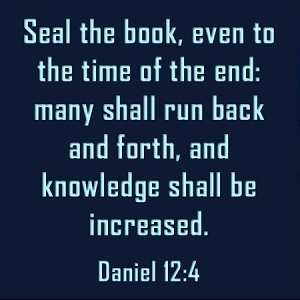
The biblical narrative repeatedly warns about knowledge divorced from wisdom - power gained without reverence. Technology itself is not condemned. But when it becomes a substitute for moral discernment and human responsibility, it accelerates destruction rather than restraining it.

 

Hi-tech travel and communicationtime of the end


Another key factor in the clock’s movement is the erosion of trust - between nations, within societies, and between people and institutions. Diplomacy depends on credibility. Science depends on shared standards of truth. Justice depends on legitimacy. When trust collapses, even small crises become unmanageable.


We now live in a world where narratives are weaponized, deception is everywhere, truth is contested, and fear is profitable. This fragmentation makes both war and societal violence far more likely, and frequent. The Bible describes such moments as times when “every man does what is right in his own eyes.” Not because people lack information, but because they lack the shared moral center the Creator has given us in His Word.


The Bible provides a prophetic Doomsday Clock of sorts of its own. I’ve talked a lot about that in the past, and that information can be found at our Tsiyon website. For now, let’s focus on patterns that serve as signs of impending judgment on the world. For example, consider these verses:

"But know this, that in the last days, grievous times will come. For men will be lovers of self, lovers of money, boastful, arrogant, blasphemers, disobedient to parents, unthankful, unholy, without natural affection, unforgiving, slanderers, without self-control, fierce, no lovers of good, traitors, headstrong, conceited, lovers of pleasure rather than lovers of God; holding a form of godliness, but having denied its power. Turn away from these." (2 Timothy 3:1-5)

 Skeptics might say that people with these traits have always existed. True, but that is not what the passage is about. Instead, it is talking about societal norms devolving to the vulgar and deranged level it describes. Read it carefully and compare it to the revelations of corruption and evil on a massive scale constantly reported in the news, social media, and all around us.


Even while technology is advancing at a break-neck pace, society is devolving even faster. The world is growing more violent, more deceptive, more divided, every day – let alone year over year. The Bible warns that in the last days knowledge would increase without wisdom, nations would be in turmoil, and hearts would be failing from fear. It describes a narrowing path between repentance and ruin.


One of the most striking biblical themes is the remnant - a people preserved not because they are powerful, but because they remain obedient to our Creator, humble, and responsive to truth in the face of growing wickedness of the world.


In the prophets, judgment does not fall because God delights in destruction. It falls because corruption becomes so entrenched that collapse is inevitable. Mercy is extended, warnings are issued, time is given - but eventually, consequences arrive.


The Doomsday Clock, in a limited and secular way, echoes that pattern. It is not directly predicting doom. But it is warning of a doomsday trajectory. In this the Doomsday Clock agrees with Scripture. The narrowing margin should force honest reflection. Not just about weapons or climate or technology - but about the kind of world now being built, and about the values of those building it.


For those who read the Bible, this is not a call to panic. It is a call to clarity. To watchfulness. To integrity. To aligning our lives with what is true, just, and enduring regardless of how the world around us behaves. Don’t be fooled into thinking that if we try hard enough we can save the world. In fact, the Scriptures take it as a foregone conclusion that we cannot save the world, and that we must not be a part of the world. Notice this:

“Don’t love the world, neither the things that are in the world. If anyone loves the world, the Father’s love isn’t in him. For all that is in the world, the lust of the flesh, the lust of the eyes, and the pride of life, isn’t the Father's, but is the world’s. The world is passing away with its lusts, but he who does God’s will remains forever.” (1 John 2:15-17)

 While it is true that the world lives on the edge of doom, the answer cannot be found in trying to save the world, because the world is already past saving. Yeshua’s plan is to save His own out of the world, and that should be our plan too. He said in prayer to His Father:

“I revealed your name to the people whom you have given me out of the world. They were yours, and you have given them to me. They have kept your word. I pray for them. I don’t pray for the world, but for those whom you have given me, for they are yours.”  John 17:6, 9

Imagine that. Yeshua/Jesus says He does not pray for the world! He is well aware that the world is a lost cause. He prays for those the Father has given Him out of the World. May that be you and I – and if that be so, then we have nothing to fear from doomsday.


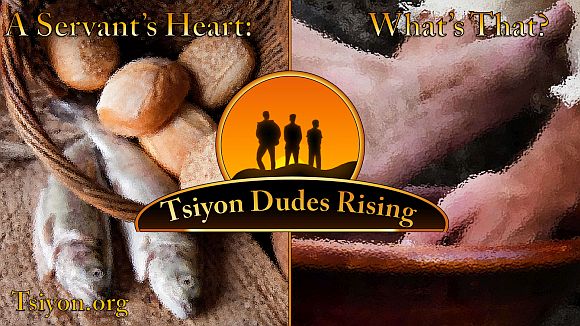
What is so different between the world and those whom the Father takes out of the world to serve Him? One important mark is a servant's heart. What's that? Tune into tonight's live stream for an insightful discussion on: A Servant's Heart: What's that? Our live stream begins at 8 Central, on Tsiyon.Net - and other popular video platforms. Find out why we are here to serve.

In His Name, Eliyahu


Contact:   https://tsiyon.org  -  https://eliyahubendavid.substack.com/


Join us tonight at Tsiyon.Net for this encouraging group discussion!

Come join us!

Special Presentation Below - Join us Feb 16th at Tsiyon.Net

Join us Feb 16th at Tsiyon.Net for this exclusive Tsiyon Member presentation!

Audio: Listen to Tsiyon RadioTsiyon Radio on TuneInSpeakerStitcher.comSpotifyGoogle Video Podcasts

Video:  FaceBookTwitterRokuYouTubePeriscopeTwitchDive.TVPodChaser

PodBeanBuzzSproutApple Video PodcastsTruthPoint Video ChannelEliyahu ben David Author Page

"Let them build Me a Sanctuary, that I may reside in their midst." Ex 25:8


Thanks to our Tsiyon Ministry Partners for your support of this ministry!
Not a Tsiyon Ministry Partner yet? Visit our Tsiyon
Website for full details.

Copyright 2026 Tsiyon

Leave feedback, prayer requests and comments here.  You may unsubscribe here.

Please help keep Tsiyon on the air! 

 Click to Donate 

Tsiyon

9901 Brodie Lane

Suite 160, Unit 1421

Austin, TX, USA, 78748


Please make offering checks to: "Tsiyon."