From Eliyahu
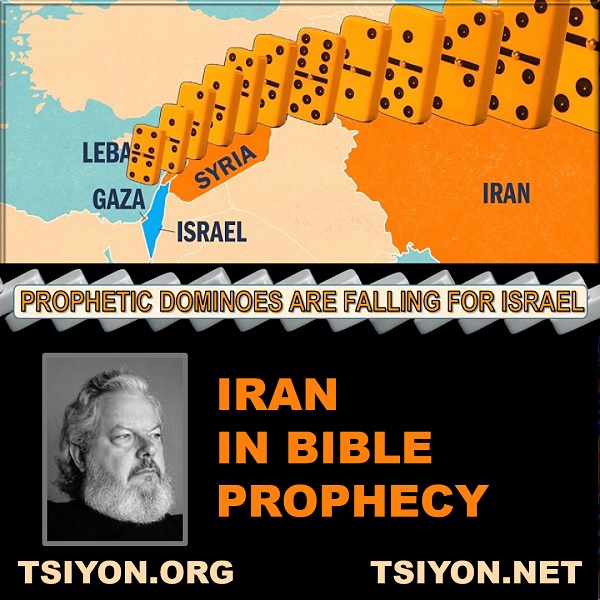
Remember my newsletter from back in the first week of 2025? It was headed
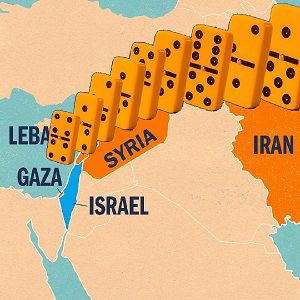
with the same picture of dominoes falling from Gaza to Iran you see above
with the title: "Prophetic Dominoes Are Falling For Israel." The first
paragraph read:
"The Iran-backed massacre of 1200 Israelis by the Hamas terror group on
October 7, 2023 has unleashed an amazing series of events in the middle-east
that, like dominoes dropping in quick succession - sees the enemies of
Israel falling, one after the other." [Tsiyon News - January 7, 2025]
I was seeing then that the big domino in the series to fall would be Iran.
Now, with the Iran conflict well under way I think it is once again time to
consider Iran in Bible prophecy. There are a lot of claims about that
swirling around. Perhaps you have been wondering which claims are Biblically
grounded, and which are mostly headline-driven?
Right now in social media bold claims that the current war with Iran is the
direct fulfillment of one Bible prophecy or another are many and varied.
With the conflict now in its second week, it is not surprising that
speculation is rising. But this is exactly when we most need clarity. The
question is not whether the present war matters. We all know it does. The
question is whether any of the specific prophetic claims now being made are
actually anchored in the text of Scripture, or whether they are mostly being
driven by headlines.
Let us begin with the claims that are obviously too loose to be very
helpful.
The first is the Armageddon theory. If we are living in the last
days, a fact I often affirm, then every major geopolitical crisis belongs to
the larger fabric of events that will eventually lead to the end of the age.
In that broad sense, yes, the present war is part of the road that leads to
the final showdown. But that is not the same as saying this war is
Armageddon. Revelation places Armageddon at the final gathering of the kings
of the earth, at the very end of the age.
To identify today’s Iran war as
Armageddon itself is Biblically in error because there are other important
Last Days events that must happen first. Could the Iran war lead to
Armageddon? On that score, the most that can be said is that this war may be
one link in a much larger chain of events that will someday culminate in
those final scenes. That is a very different claim, and a much more modest
one.
The same caution applies to the Isaiah 17 / Damascus theory. Could
the present Iran war contribute to a future Damascus scenario? Of course it
could. Syria remains part of the broader regional picture, and present
tensions could spill over in many directions. But there is nothing in Isaiah
17 that directly identifies this Iran war with that prophecy. Yet, some who
claim to be Bible teachers in social media talk as if this war must bring on
the prophesied destruction of Damascus. If teachers build up strong
expectations that the Iran war must lead to the Isaiah 17 scenario, and then
it does not happen that way, the result can be confusion and unnecessary
discouragement. We should avoid that.
Now let us define some terms.
Is it accurate to say that the Persia of Ezekiel 38 and the modern
nation of Iran refer to the same place? Broadly speaking, yes. The
region long known in the West as Persia is the same region whose people have
traditionally called it Iran, “Land of the Aryans.” Britannica notes that
“Iran” became the official international name in 1935, but the two terms are
deeply connected historically and geographically. So when Ezekiel 38 names
Persia among Gog’s allies, it is not a stretch to see a real modern
connection to Iran. That does not solve every interpretive question in
Ezekiel 38, but it does mean that this is one of the few current prophecy
claims about Iran that has a genuine textual anchor.
What about Elam? Is that also just another Biblical name for Iran?
Here we need to be much more careful. Elam was an ancient civilization in
what is now southwestern Iran, but it was not simply an early name for the
later Persian people. It predated the Persian Empire and was culturally
distinct, even though it was eventually absorbed into the Persian world. So
while Elam is tied to the geography of modern Iran, it is not identical with
Persia. That means the common claim now circulating that Jeremiah 49 is
obviously a prophecy about modern Iran is much more speculative. Could Elam
have implications for modern Iran? Perhaps. But we should admit that the
identification is uncertain.
This is why I believe the strongest direct Iran connection in Bible prophecy
is still Ezekiel 38, not Jeremiah 49. Persia is actually named there.
The complication, however, is that Ezekiel 38 also describes Israel as
dwelling in a condition of relative security, at rest, in unwalled villages.
That does not fit the present moment very neatly. So while Persia in Ezekiel
38 can reasonably be understood as modern Iran, it does not automatically
follow that the current war is the Gog of Magog battle – with many
other reasons also disallowing that conclusion. The text gives us a real
anchor for Iran in Scripture, but not a license to force the entire chapter
onto today’s headlines.