Isaiah also adds another beautiful note in Isaiah 27:12–13, where YHWH says He
will gather the children of Israel “one by one.” I love that phrase. It is
intimate. It is personal. It reminds us that the remnant is not restored by
accident or by broad historical movement alone. The God of Israel knows His
people, and He gathers them one by one. Yes, He knows who you are, even better
than you know yourself.
Not surprisingly, Jeremiah speaks with the same hope.
In “Jeremiah 23:3-8”, YHWH says, “I will gather the remnant of My flock out of
all countries where I have driven them, and will bring them again to their
folds.” He promises that they will be fruitful and increase. The restoration is
so great that Jeremiah says this Second Exodus will eclipse the memory of the
Exodus from Egypt.
That is extraordinary language.
Jeremiah is telling us that the future regathering of the remnant will be one of
the defining acts of YHWH in history.
Then in “Jeremiah 31:7-10”, the prophet says, “Save Your people, the remnant of
Israel.” He describes YHWH bringing them from the north and gathering them from
the ends of the earth. Once again, the same great theme is front and center: the
remnant of Israel is not forgotten. YHWH will regather them.
Jeremiah is also especially helpful because he makes clear that this hope
includes “both Israel and Judah”. In “Jeremiah 30:3”, YHWH says He will bring
again from captivity “My people Israel and Judah.” And later in the chapter he
says that “in the latter days” the people will understand it.
That combination is so important:
Israel and Judah together,
return to the Land,
and a latter-days setting.
So when Ezekiel 37 speaks of the dry bones living and the two staffs becoming
one, Jeremiah is standing there beside him as a second witness.
Hosea is one of the most important parallels of all.
In “Hosea 1:10-11”, after announcing judgment, the prophet says that the
children of Judah and the children of Israel will be gathered together and
appoint themselves “one head”. That language is wonderfully close to Ezekiel 37.
The divided people are no longer divided. They are gathered and brought under
one head.
Then in “Hosea 3:4-5”, Hosea becomes even more explicit. Israel will remain many
days without king, prince, sacrifice, and the rest. But afterward, they will
return and seek “YHWH their God and David their king”, and they will come
trembling to YHWH and to His goodness “in the latter days”.
There it is again:
The latter days,
Return to YHWH,
David their king.
That is the same cluster of ideas we find in Ezekiel 37. The restored people
do not simply come back to a piece of land. They are restored covenantally,
spiritually, and kingly. They come back to YHWH, and they come back under
the Messiah.
We could go on to Micah and Zechariah, who add their own light to the
picture, and more. When I step back and look at all of this together, what
strikes me most is the consistency. That is not a random collection of
disconnected texts. That is a prophetic pattern.
The prophets repeatedly speak of:
The remnant,
The regathering,
The reunion of the divided house,
The return to the Land,
And the rule of one Davidic shepherd.
That is why Ezekiel 37 carries so much weight. It gathers all of those
themes into one unforgettable vision. The bones live. The divided staffs
become one. The people return. David rules. YHWH is known.
The regathering of the remnant of Israel in the latter days is not a side
note in Scripture. It is not a fragile idea built on one isolated vision. It
is one of the great themes of the prophetic books. The very reputation of
YHWH, the God of Israel, is invested in bringing all of these promises into
reality in these last days.
Developments in the news today not only indicate we are well along into the
Latter Days, but also that we are moving closer to the remnant return than
anyone can imagine - if they even know about the remnant return. Nevertheless,
these events are on my radar screen and I want to share what I have on this with
our faithful Tsiyon members.
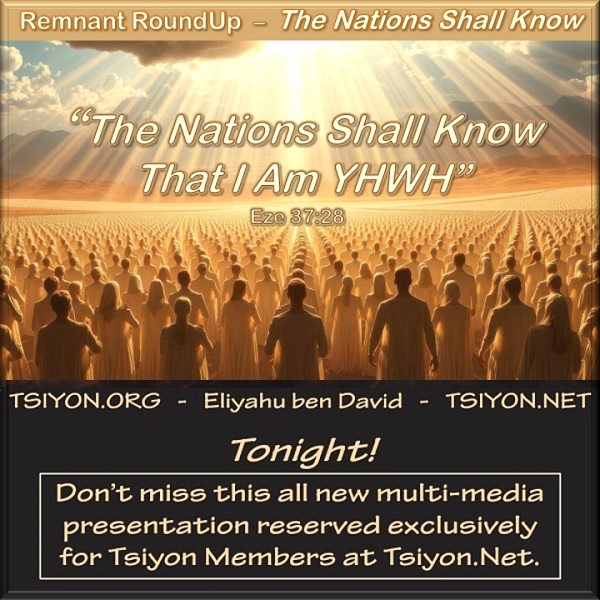
Tonight I have an exclusive Remnant RoundUp presentation lined up just
for you! We have enhanced this teaching with unique music and multi-media
features to raise this presentation to a higher level for our Tsiyon members. It
is entitled: The Nations Shall Know.
Our
timer program starts at 7:45 PM Central and will include songs and lyrics from
earlier presentations. At 8 PM
our meeting begins, bringing you The Nations Shall Know. If you live in a
different time zone be aware that daylight savings time went into effect here
last week, so you should double-check the time for your area. Since this is an
exclusive presentation for our beloved Tsiyon members this stream will only be
broadcast from
Tsiyon.Net - that's at 8 PM,
Central. Don't miss this special presentation.
In His Name, Eliyahu
Contact: https://tsiyon.org - https://eliyahubendavid.substack.com/