https://tsiyon.org/images/230801NL/What makes a person mighty in the Scriptures, and why you should care.

TSIYON NEWS

Tsiyon Messianic Radio Newsletter  - Vol 21.12 - 01/07/6026 TAM - 03/26/2026 AD

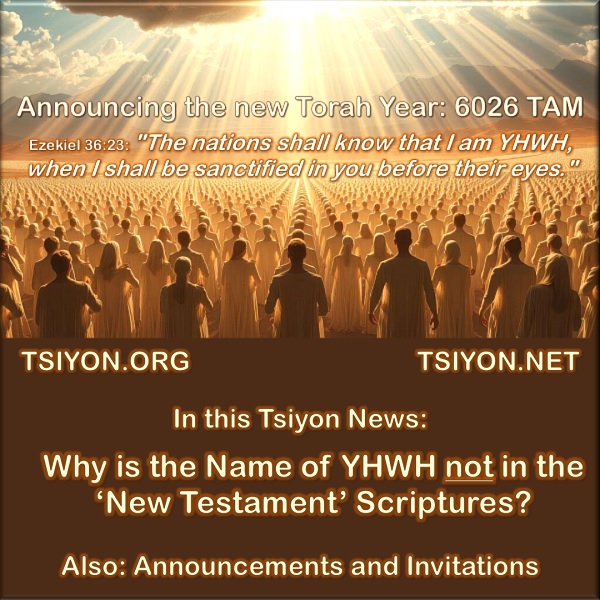
The Nations Shall Know


From Eliyahu


As of sundown of March 20, 2026, we have been in a new Torah Year. Our Scripture theme for this year is taken from Ezekiel 36:23:

“The nations shall know that I am YHWH, when I shall be sanctified in you before their eyes.” Ezekiel 36:23

This verse reminds us that the Great Name of YHWH is closely identified with His people, remnant Israel. As we begin this New Year we want to do so focusing on the awesome Name of our God.


One question some people have is this: Why is the name of YHWH not in the Greek NT Scriptures at all, while it is included in the Hebrew Scriptures over 7,000 times? This fact is not very apparent from most English language translations, since they generally replace the Name YHWH with the title LORD. That has the effect of obscuring the great frequency of the use of the Divine Name for many readers. Nevertheless, in the Hebrew original the actual Name is everywhere, so why not in the Greek NT Scriptures?


Could it really be that Yeshua and His disciples never used the Divine Name? Consider Yeshua’s Priestly Prayer the night before His death:

“..Holy Father, keep them through your name which you have given me that they may be one, even as we are.  While I was with them in the world, I kept them in your name.” (John 17:10-12)

Here we learn from the mouth of Yeshua Himself that He “kept them” in the Father’s Name. Clearly, Yeshua and His disciples used the Divine Name, and were, in fact, united in that Name. So, why isn’t it in the Gospels?


Actually, we can be pretty sure it was in the original Hebrew Gospel of Matthew. That’s right. Matthew was authored in Hebrew and was later translated into Greek. Our English Bibles are translated from the Greek version. The “Church Fathers” from about the 2nd century onward affirm that Matthew was written in Hebrew:

Papias (early 2nd century) - “So then Matthew wrote the oracles in the Hebrew language, and every one interpreted them as he was able.” Source: Eusebius, Church History. 3.39.


Irenaeus (c. 130–202) - “Matthew also issued a written Gospel among the Hebrews in their own dialect.” Source: Against Heresies. 3.1.1.


Origen (c. 184–253) - “The first was written by Matthew … and published in the Hebrew language.” Source: Eusebius, Church History. 6.25.


Pantaenus tradition (reported by Eusebius, early 4th century) - “Bartholomew … left with them the writing of Matthew in the Hebrew language.” Source: Eusebius, Church History. 5.10.


Jerome (c. 347–420) - “Matthew … composed a gospel of Christ at first published in Judea in Hebrew.” - Source: De Viris Illustribus. 3.

It is quite conclusive that Matthew was originally written in Hebrew. So the next question is: Did the original Hebrew Matthew use the Divine Name?


Sadly, the original Hebrew Matthew was burned by the Catholic Church, but it seems, some descendants from it survived. Consider the claims of George Howard, PhD.


George Eulan Howard, PhD (June 3, 1935 – November 21, 2018) was a specialist in Jewish, Hebrew and Hebraic studies, and in Theology. His Hebrew Gospel of Matthew was a major contribution of his career. He wrote about that book in an article in Bible Review, with this heading:


Was The Gospel of Matthew Originally Written In Hebrew? By George Howard [Bible Review, Winter, 1986]


The article begins with these words from Howard:

"New evidence indicates that the Gospel of Matthew was an original Hebrew composition. Indeed, it is now possible to recover much of this original Hebrew composition from an extant manuscript."

I have a copy of Howard's English translation of Hebrew Gospel of Matthew sitting on my desk in front of me. It contains the entire Hebrew text of Matthew owned by a 14th century Jew named Shem-Tob, who was using that Hebrew Matthew to refute Christians. In his Hebrew Gospel of Matthew George Howard includes that Hebrew text, as well as an English translation of it.


Howard argued for mediated descent from an earlier Hebrew Matthean tradition. In other words, he was saying that the Shem-Tob Matthew in Hebrew was not a translation from the Greek version of Matthew most English Bibles are translated from. Rather, it appears to be from an original Hebrew strand that likely descends from the original Hebrew Matthew.


In his 1986 Bible Review article, Howard stated that claim in very strong form: Matthew was originally composed in Hebrew, and much of that Hebrew could be recovered from the extant manuscript tradition preserved in Shem-Tob’s Even Bohan. I should also note, some other scholars disagreed with that, which is to be expected.


George Howard includes Part Two Analysis and Commentary in his book, which lays out a lot of technical proofs for his contentions. Not the least of these is the fact that at Matthew 28:9 the Divine Name is fully written out in the Hebrew text. Abbreviated forms of the Divine Name occur in the Shem-Tov Hebrew text at all of these verses: Matt 1:22; 1:24; 2:13; 2:19; 3:3; 4:7; 4:10; 21:9; 21:12; 21:42; 22:31; 22:32; 22:37; 22:44; 23:39; 27:9; 28:2; Matt 5:33.

 

Hebrew MatthewDivine Name


What are we to make of the Divine Name actually being included in the Hebrew text of Matthew? George Howard argues that this feature was not likely inserted by Shem-Tob. In a later quoted passage, Howard says, “No Jewish polemist would have done that.”


Indeed, the presence of the Divine Name in the Hebrew Matthew, in my view, was most likely there from the start, in the text of Matthew’s original gospel written in Hebrew. I believe this because it is entirely in keeping with Messiah’s prayer that He ‘kept them in Your [YHWH’s) Name’. Well, this might leave us wondering if there were any other NT books originally written in Hebrew. There is some evidence for that.


Some scholars point to Hebraisms in Revelation. Hebraisms are a Hebrew way of speaking and grammar, but written in somewhat awkward Greek. Hebraisms in Revelation are widely recognized. Some scholars see this as pointing to a Hebrew original. For example, C. C. Torrey argued for an Aramaic original, and R. B. Y. Scott argued for a Hebrew original, while Greek supporters look for other explanations.


Even so, all sorts of commentators often connect Revelation 1:4 to the divine-name language of Exodus 3:14. Also, Revelation is Apocalyptic in form, which is native to Hebrew, so I believe it was originally written in Hebrew and only later was translated into Greek. After all, Yochanan (John) like all of the apostles, was Jewish.


Another example, we have “Church Fathers” who claim the book of Hebrews was written in Hebrew. Here’s a couple of quotes:

Clement of Alexandria (c. 150–215) - “The Epistle to the Hebrews … was written to the Hebrews in the Hebrew language” Source: Eusebius, Church History. 6.14.


Jerome (c. 347–420) - “He [Paul] being a Hebrew wrote Hebrew, that is his own tongue and most fluently.” Source: De Viris Illustribus. 5.

This last quote is especially interesting to me. While Jerome is making a case there for Paul as a Hebrew writing the book of Hebrews in Hebrew (which only makes sense considering its name) why wouldn’t that apply to all of Paul’s letters as well? And if Paul, Matthew, and John, why not all of the apostles, who were also Hebrews? Is it not likely that they all wrote in Hebrew and that what came from them was immediately and/or eventually translated into Greek as the Gospel spread?


Actually, George Howard thought that was the case. He also presented an interesting reason why the Name was not used in the Greek translations from which our English Bibles are translated. He said:

“Gentile Scriptures did not use the Tetragrammaton for the same reason that English Bibles do not print God's name as יהוה. Rather, all English Bibles transform it into a meaningful English equivalent. (That is, neither "Yahweh" nor "Jehovah" is the Tetragrammaton. Yahweh is, at best, an approximate transliteration of the Tetragrammaton.) At the meridian of time, Hebrew language and writing were as foreign to the average Greek Gentile reader as it would be to the average English reader today. We often overlook this reality when we presume that there would have been a natural recognition of the divine name had the Tetragrammaton been inserted into the "ancient" biblical texts. Because of Alexander the Great's legacy and the subsequent power of the Roman Empire, the Greek language was widely used in the Gentile world. This was not the case, however, with Hebrew. Hebrew was a highly parochial language dialect. Nonetheless, for today's English translations, the choice of an Anglicized form of the divine name is far preferable in the Hebrew Scriptures to the traditional "LORD" written in capital letters used in most English versions.” Source: areopage[dot]net/howard.pdf

Basically, Howard is saying the Hebrew name of God was not easily recognizable to Greek-speaking people, so when translating from the Hebrew originals into Greek a substitute for the Divine Name was used – just as most English Bibles do for the same reasons. This is why “LORD” is substituted for YHWH in most English Bibles.


Regarding the Greek manuscripts, I believe they faithfully convey the truth of original Hebrew manuscripts, even though they apparently used substitutions for the Divine Name to make the message understandable to the large Greek-speaking population, even as English translations do today. That does not diminish the importance of the Divine Name. YHWH Himself defined the importance of the Name, and that can’t change.


At our live-stream tonight Brother Michael will be hosting a panel discussion focusing on more about the Divine Name and how it relates to the remnant. You won't want to miss that, tonight at 8 PM Central at Tsiyon.Net - and other popular streaming sites.


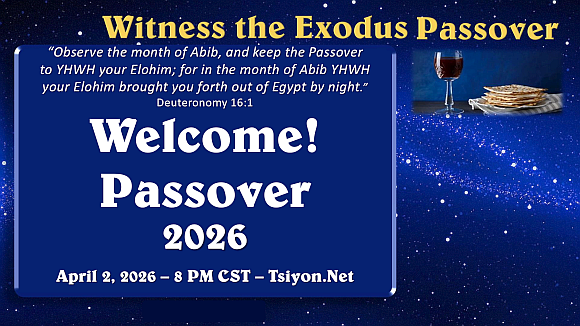
One week from tonight, April 2, beginning at 8 PM, Central, we will be live-streaming our Passover celebration. Don't miss this special Passover presentation, and don't forget your Matzo and Wine to partake together with us in the New Covenant, in Yeshua Messiah,

on Passover.


In His Name, Eliyahu


Contact:   https://tsiyon.org  -  https://eliyahubendavid.substack.com/

Join us for Passover! - April 2, 2026, 8 PM Central, at Tsiyon.Net

You are invited!

Audio: Listen to Tsiyon RadioTsiyon Radio on TuneInSpeakerStitcher.comVideo & Audio PodcastsSpotifyGoogle Video Podcasts

Video:  FaceBookTwitterRokuYouTubePeriscopeTwitchDive.TVPodChaser

PodBeanBuzzSproutApple Video PodcastsTruthPoint Video ChannelSee TruthPoint Videos!Eliyahu ben David Author Page

"The nations shall know that I am YHWH,

when I shall be sanctified in you before their eyes." Eze 36:23


Thanks to our Tsiyon Ministry Partners for your support of this ministry!
Not a Tsiyon Ministry Partner yet? Visit our Tsiyon
Website for full details.

Copyright 2026 Tsiyon

Leave feedback, prayer requests and comments here.  You may unsubscribe here.

Please help keep Tsiyon on the air! 

 Click to Donate 

Tsiyon

9901 Brodie Lane

Suite 160, Unit 1421

Austin, TX, USA, 78748


Please make offering checks to: "Tsiyon."