https://tsiyon.org/images/230801NL/What makes a person mighty in the Scriptures, and why you should care.

TSIYON NEWS

Tsiyon Messianic Radio Newsletter  - Vol 21.14 - 01/21/6026 TAM - 04/09/2026 AD

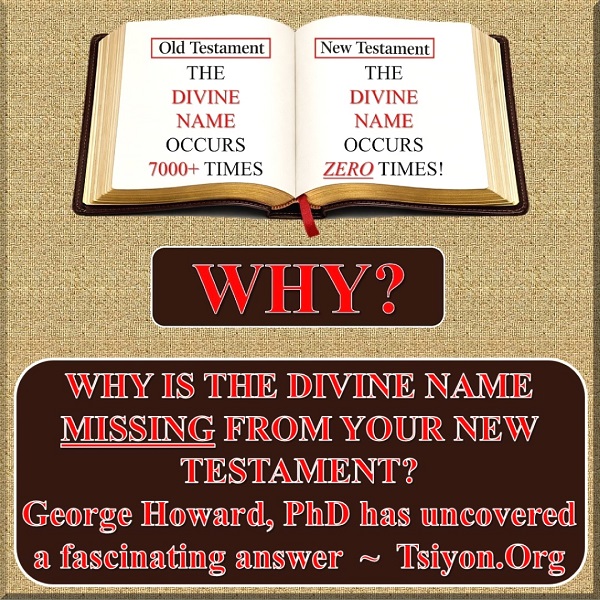
The Missing Divine Name


From Eliyahu


From time to time I run across a line of research that makes me stop and think, That would explain a great deal. George Howard's theory about the Divine Name in the New Testament is one of those. He lays this out in: The Tetragram and the New Testament by George Howard, PhD.


I want to be clear at the outset: this is a theory. It is not something all scholars accept, and I am not presenting it here as though every question has been settled. But I do think it is serious, thoughtful, and historically grounded enough to deserve a careful hearing. And the more I have looked at it, the more I can see why it is worth considering.


Howard's basic claim is simple to state, even if the details behind it are not simple at all. It starts from the fact that no universally accepted first-century New Testament manuscripts survive. The earliest fragments commonly accepted by scholars are usually dated to the late second century or around 200 AD. Howard believes first-century NT manuscripts contained the Divine Name, while the later manuscripts our modern Bibles are translated from do not.


He argued that the Divine Name originally stood in New Testament quotations of the Old Testament, and perhaps in some allusions as well, and that later copyists replaced it with the Greek words usually translated Lord and sometimes God. In his view, this change took place in the second century, as the Gentile Christian Church emerged. Once that happened, the written form of the Divine Name disappeared from the New Testament manuscript tradition, even though Howard presents a good argument that it may once have stood there.


What makes Howard's theory so interesting is that he does not begin by asking us to imagine something with no evidence behind it. He begins with the Greek Old Testament.


Many Christians assume that when the Hebrew Scriptures were translated into Greek, the Divine Name was simply replaced everywhere with the Greek word for Lord. Howard argued that the earliest evidence does not support that assumption. In some very early Greek Biblical manuscripts, the Divine Name is not replaced at all. Instead, it is preserved in Hebrew letters within the Greek text, or reflected in special forms. That is a very important point, because it means the earliest Greek Scriptures known to Jews and early believers visibly contained the Divine Name.


That matters because the first believers did not inherit Scripture in a vacuum. They inherited it from the Jewish world. And if their Greek Scriptures still preserved the Divine Name in the biblical text, then it becomes much easier to imagine that the New Testament writers would have preserved it too when quoting those Scriptures.


Howard strengthens this case by looking at the Judean Desert material, including Qumran. Here he sees a pattern that I find especially compelling. In Biblical manuscripts and in direct quotations from Scripture, the Divine Name is carefully preserved. But in commentary, explanation, and paraphrase, substitute expressions are often used instead. In other words, ancient Jewish scribes seem to have made a distinction between the wording of Scripture itself and the language used to discuss Scripture.


That distinction is important. It means a scribe could preserve the Divine Name in the Biblical text and still use a substitute title such as God or Lord in explanatory remarks. Howard sees this as a key to understanding what may have happened later in Christian transmission. The issue is not merely how people spoke about God in general conversation. The issue is what stood in the sacred text itself.


He also notes that ancient reverence for the Divine Name could produce a variety of practices. Sometimes the Name was written. Sometimes a substitute was spoken aloud when the text was read. Sometimes special marks or substitute forms were used. So the question is not whether ancient people treated the Divine Name with reverence. Clearly they did. The question is whether that reverence originally coexisted with preserving the Name in writing, and whether later scribes moved from preservation to substitution.


Howard believes that it did.


He even treats Philo as a kind of bridge witness. Philo was a leading writer of the Hellenistic Jewish community in Alexandria, Egypt in the first century.  The writings of Philo, as they survive, often contain the Greek word Lord in Biblical quotations. But Howard cautions the works of Philo came down through Christian hands, which means later updating may have affected the text. At the same time, Philo does seem comfortable using surrogate titles when discussing God. Again, this fits the same broader pattern: preserve the sacred wording in Scripture, but use substitutes in exposition.


From there Howard makes his main proposal. If the earliest believers were using Greek Scriptures in which the Divine Name still stood in Old Testament quotations, then the New Testament writers likely retained it when they quoted those texts. But later, as Christian scribes copied both Testaments, they replaced the Divine Name with surrogate expressions such as Lord and God. Howard places this shift in the early second century.


The NAMEReplaced


That is a major claim, and it leads to a second one that may be even more important. Howard argues that once the Divine Name was replaced by Lord, certain passages became more ambiguous than they had originally been. A text that once clearly distinguished the God of Israel from the Messiah might now be read in a way that blurred the distinction. He does not argue that every theological development came from this, or that every New Testament textual problem can be explained by it. But he does think that once the Divine Name disappeared from the text, some passages naturally became easier to misunderstand or reinterpret.


That point is one reason this theory matters so much. Howard is not just suggesting a change in wording. He is suggesting a change that may have affected how later generations read the New Testament.


And to me, that is where the theory becomes especially worth thinking about.


There is another part of this that seems historically believable as well, even though it is harder to prove in a strict sense. There is no ancient church writer, so far as I know, who comes right out and says: We removed the Divine Name because Hebrew and Jewish things had fallen into disfavor.


But we do know that the second century was a time of enormous change.


The Roman-Jewish wars had shattered the Jewish world. The destruction of Jerusalem in 70, and then the later conflict under Hadrian, changed everything. In the generations that followed, the assembly became increasingly Gentile to the point of schism, and the distance between Gentile Christianity and Hebraic Faith was drawn sharper and sharper. That much is plain from the sources.


When you read writers such as Justin Martyr, you can feel that change in the air. His world is not the world of the earliest Jerusalem assembly. It is a world in which Christianity is increasingly defining itself over against Judaism, even while continuing to claim the Scriptures of Israel as its own. The older Jewish setting is still there in the background, but the center of gravity has shifted to the Gentile world. Justin even claimed the Greek philosophers as spokesmen for God.


A visibly Hebrew Divine Name may have seemed natural in an assembly still deeply rooted in the Hebrew world. It may have seemed less natural in a Gentile church that was becoming more Gentile by the decade, more distant from Jewish life, and more accustomed to Greek sacred terms such as Lord and God. Add to that the reverential use of abbreviated sacred forms in Christian copying, and one can see how a substitution that began as a scribal habit could become a settled textual tradition.


In that sense, The Howard proposal fits its historical setting rather well.


He even suggests that Jewish believers may have preserved the Divine Name longer than the Gentile church did. That too makes historical sense. A believing Jewish community, still close to the habits of the synagogue and the text of the Hebrew Scriptures, would have had a stronger reason to retain the Divine Name in writing. A Gentile church, especially one no longer able to read Hebrew and increasingly separated from Jewish life, would have had far less reason to do so.


And once the change had taken hold, later generations might not even realize that the Divine Name had been lost from copies of the NT.


That, perhaps, is the most striking part of the Howard theory. It suggests that a very early and very important change may have happened so quietly that, after a while, most believers simply inherited the new form of the text without knowing there had ever been another.


Now, to be fair, this remains a theory. Not every scholar agrees with Howard. I am not trying to settle all of that here. My purpose is simpler. I want readers to understand what Howard is actually saying, and why his proposal has struck many people as reasonably plausible.


He is saying that the Divine Name may once have stood in the New Testament wherever the Old Testament was being quoted; that later Christian scribes replaced it with Lord or God; that this likely happened in a more thoroughly Gentile phase; and that the result was not merely a change in wording, but a change that may also have affected interpretations of the text.


That is one reason I find this study so thought-provoking. It touches Scripture, history, language, identity, and the long transition from an authentic movement born within Israel to a Gentile off-shoot spread across the nations. And in that transition, it asks whether something precious may have slipped quietly from view in the NT from all but the most diligent.


Here is where grounding in the Hebrew Scriptures foundation becomes so important for understanding and interpreting the NT. God is one and His word one. We know YHWH gave us one harmonious word, from beginning to end, and that word as He spoke it has been transmitted through Israel as His covenant people. As Paul wrote:

Israel! They were made God's children, the Sh'khinah has been with them, the covenants are theirs, likewise the giving of the Torah, the Temple service and the promises; the Patriarchs are theirs; and from them, as far as his physical descent is concerned, came the Messiah, who is over all. Praised be Adonai forever! Amen. (Romans 9:4-5 CJB)

It is not a small thing that the Divine Name was apparently removed from the Greek Scriptures (NT) and subsequently from English translations. This has major uncomfortable implications regarding the development of the theology and practices of the Christian Church. Remember, when Yeshua prayed to His Father "Hallowed be thy Name" YHWH is the Name He was talking about!


Join us tonight, April 9, 2026, at 8 PM, Central, for a stimulating panel discussion on our live stream. Find us on Tsiyon.Net, or on other popular streaming platforms.


In His Name, Eliyahu


Contact:   https://tsiyon.org  -  https://eliyahubendavid.substack.com/

From meaning to pronunciation - this exclusive presentation has it all!

You are invited!

Audio: Listen to Tsiyon RadioTsiyon Radio on TuneInSpeakerStitcher.comVideo & Audio PodcastsSpotifyGoogle Video Podcasts

Video:  FaceBookTwitterRokuYouTubePeriscopeTwitchDive.TVPodChaser

PodBeanBuzzSproutApple Video PodcastsTruthPoint Video ChannelSee TruthPoint Videos!Eliyahu ben David Author Page


"The nations shall know that I am YHWH,

when I shall be sanctified in you before their eyes." Eze 36:23


Thanks to our Tsiyon Ministry Partners for your support of this ministry!
Not a Tsiyon Ministry Partner yet? Visit our Tsiyon
Website for full details.

Copyright 2026 Tsiyon

Leave feedback, prayer requests and comments here.  You may unsubscribe here.

Please help keep Tsiyon on the air! 

 Click to Donate 

Tsiyon

9901 Brodie Lane

Suite 160, Unit 1421

Austin, TX, USA, 78748


Please make offering checks to: "Tsiyon."