Once
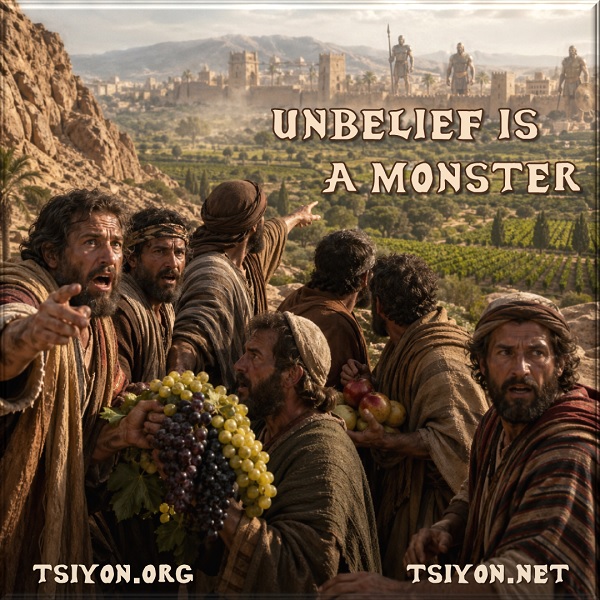
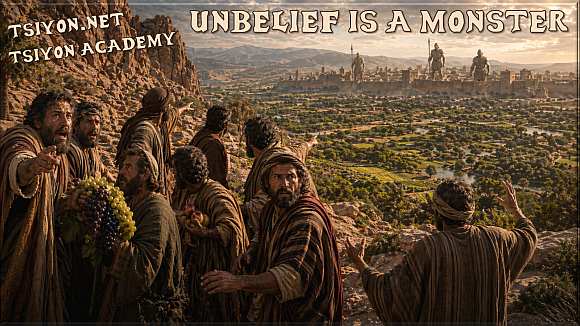
again, the soul stands at the edge of the land.
And
here is where believers need to understand something deeply: fear itself is
a human response, but if fear is allowed to rule, it ripens into unbelief.
The issue is not that the Israelites felt the size of the challenge. The
issue is that they interpreted the challenge apart from the power and
faithfulness of YHWH.
That
is still the danger now.
Scripture does not ask us to pretend there are no giants. It asks us to
remember who YHWH is. Moses said to Israel,
“Don’t dread, neither be afraid of them. YHWH your God who goes before
you, he will fight for you, according to all that he did for you in
Egypt before your eyes, and in the wilderness, where you have seen how
that YHWH your God bore you, as a man does bear his son, in all the way
that you went, until you came to this place.” (Deut 1:29-31)
That
is the answer to the crisis of the threshold. Remember who brought you here.
Remember who carried you. Remember what He has already done. Remember that
the One who brought you to this point did not do so to abandon you in front
of the obstacle.
That
is why unbelief is so serious. It is never merely a misreading of the
present. It is also a forgetting of the past.
The
Israelites did not fall because YHWH was absent. They fell because they
allowed present fear to overpower remembered faithfulness. They stood at the
very point where trust should have matured into action - and instead
it collapsed.
The
writer of Hebrews reaches back to that moment and makes clear that the
wilderness generation failed to enter in because of unbelief. That warning
is not preserved for ancient history only. It is given because the pattern
continues. People can hear the promise, approach the promise, even desire
the promise, and still fail to enter because faith gives way to fear.
So what helps believers push through?
First, believers need to recognize the threshold moment for what it is.
Not every hard place is a warning to stop. Sometimes it is the final
resistance before breakthrough. Sometimes the very presence of giants means
you are standing near something worth taking. If YHWH has truly brought you
to that point, opposition is not proof that you missed Him. It may be proof
that you are exactly where decisive trust and faithful action is now
required.
Second, believers must learn to answer fear with remembered
faithfulness. The enemy of your soul wants you to stare at the walls
immobilized. YHWH calls you to remember the Red Sea, the manna, the cloud,
the fire, the mercies, the providences, the prayers answered, the times you
were carried when you could not carry yourself. Faith is strengthened when
memory is made obedient to truth.
Third, believers need to refuse the language of retreat. Israel murmured
in their tents. That detail is striking. Fear loves private conversation,
repeated inwardly and reinforced among the fearful. It grows in the
atmosphere of complaint, exaggeration, and mutual discouragement. If you
rehearse the size of the giants without rehearsing the greatness of YHWH,
unbelief will gain ground. The believer must interrupt the inward murmur and
answer it with the word of YHWH.
Fourth, obedience often requires movement before emotional certainty
arrives. Many people wait to feel fearless before they move. That is not
usually how faith works. Faith moves because YHWH has spoken, not because
all trembling has vanished. Courage is not the absence of fear. It is the
act of trusting YHWH enough to obey while fear is still trying to speak.
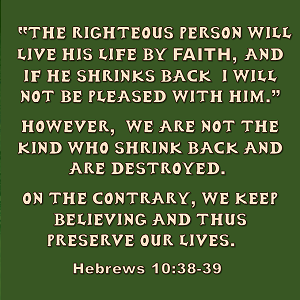
Fifth, believers must understand that stepping back has consequences.
Israel’s refusal was not a neutral pause. They did not remain at the edge
forever. They lost the future that had been set before them and died in the
wilderness instead. That is sobering. There are seasons in which stepping
back from trust leads to years of unnecessary loss. YHWH is merciful, and He
is able to restore much, but that does not make unbelief harmless. The
blessing you refuse will go to someone else.
There are many believers today living in futures they do not like because,
at some earlier point, they stepped back from trusting YHWH through
something difficult. They drew back from obedience, from courage, from
surrender, from forward movement, and now they find themselves in a
wilderness of delay, frustration, and dissatisfaction. Not every hard season
is caused by unbelief, of course. But some are. And wisdom requires us to
admit that.
Yet there is also hope in this.
The
answer is not to become harsh with ourselves or others. The answer is to
return to the place where trust is restored. Joshua and Caleb saw the same
land, the same walls, and the same giants. The difference was not that they
were blind to reality. The difference was that they measured reality by
YHWH, not YHWH by reality. Remember the Name of the one who transcends our
reality: "I will be with you."
That is still the dividing line.
When
believers keep trusting YHWH, they overcome - not because the road becomes
easy, but because the One who called them remains faithful. Doors open.
Strength comes. Timing unfolds. Battles are won. Character grows. Futures
change. Destinies are entered not by human bravado, but by persevering
trust.
So
perhaps the question for each of us is this:
Where have I come to the edge and stepped back?
Where have I allowed fear to disguise itself as wisdom?
Where have I talked myself out of obedience because the giants looked too
large?
And
where is YHWH, even now, calling me not merely to admire the land from a
distance, but to go forward and enter in?
There is a kind of sorrow that comes from never having had the opportunity.
But there is another sorrow, even greater, that comes from having stood at
the threshold, having seen the goodness of what YHWH set before you, and
then having turned away. This is not simply "missing His highest will" -
this is disobedience.
May that not be your story.
May
you not die in the wilderness with promise in view and unbelief in your
heart.
May
you remember the One who brought us here.
May
you trust the One who goes before us.
And
when the moment comes to cross over, may you not step back.