https://tsiyon.org/images/230801NL/What makes a person mighty in the Scriptures, and why you should care.

TSIYON NEWS

Tsiyon Messianic Radio Newsletter  - Vol 21.19 - 02/28/6026 TAM - 05/15/2026 AD

you are invited

eliyahubendavid.substack.com/


From Eliyahu


Nebuchadnezzar is ancient history, right?


Not exactly.


There are moments in Scripture that do more than tell us what happened long ago. They reveal patterns that continue to appear in every age. Daniel 3 is one of those moments.

“Nebuchadnezzar the king made an image of gold, whose height was sixty cubits, and its breadth six cubits: he set it up in the plain of Dura, in the province of Babylon.” Daniel 3:1

The image was enormous. If we use the common estimate of an eighteen-inch cubit, it stood about ninety feet high. Some say the Babylonian cubit was three fingers more, which would put the image over a hundred feet. Even if the exact measurement varied, Daniel’s point is clear: this was built to dominate the senses of all of the officials of the empire gathered there on the plain of Dura. Notice this:

“Then Nebuchadnezzar the king sent to gather together the satraps, the deputies, and the governors, the judges, the treasurers, the counselors, the sheriffs, and all the rulers of the provinces, to come to the dedication of the image which Nebuchadnezzar the king had set up.” Daniel 3:2

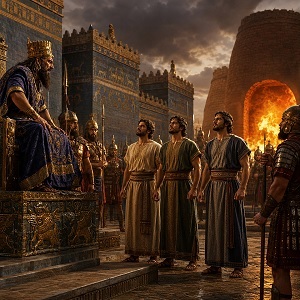
We are meant to feel the scale of the event. Nebuchadnezzar gathered the whole machinery of government: rulers, administrators, judges, treasurers, counselors, sheriffs, and provincial officials. These men were not all native Babylonians. Daniel describes the audience as “peoples, nations, and languages.” Babylon had conquered kingdoms, deported peoples, and reorganized nations under its rule. So before this golden image stood representatives of an empire.


What was the point?


Whatever name the image may have carried, and whatever god may have been associated with it, the image functioned as a visible symbol of Babylonian power. This was a loyalty test. It said, in effect: Your former nation is gone. Your former gods have failed. Your former loyalties must now bow before Babylon.


Then came the sound.

“Then the herald cried aloud, To you it is commanded, peoples, nations, and languages, that whenever you hear the sound of the horn, flute, zither, lyre, harp, pipe, and all kinds of music, you fall down and worship the golden image that Nebuchadnezzar the king has set up.” Daniel 3:4–5

In our day, music is everywhere. But in the ancient world, most people would never hear anything like a royal orchestra assembled on this scale. This was sound as power. Sound as spectacle. Sound as emotional pressure.


Imagine standing there. Before you is a golden image towering over the plain. Around you are the officials of the empire. Then the instruments begin to play. One by one, then all at once, the crowd begins to bow. That is not merely worship. That is social pressure. That is emotional pressure. That is political pressure. That is the pressure of spectacle, music, authority, and the crowd all moving in the same direction.


Nebuchadnezzar did not need to explain everything. He created the moment. The image, the officials, the music, the command, and the crowd all sent the same message: Everyone important is bowing. Everyone wise is bowing. Everyone who wants to live is bowing. And just in case the pageantry did not persuade everyone, Nebuchadnezzar added one more element.

“Whoever doesn’t fall down and worship shall the same hour be cast into the midst of a burning fiery furnace.” Daniel 3:6

That is the final piece of the mind control scheme: terror.


So now the pressure is complete. There is the pressure of authority. There is the pressure of the crowd. There is the pressure of music and emotion. There is the pressure of public visibility. And there is the pressure of death.


This is why Daniel 3 is not merely a story about an idol. It is a story about coercion. It is a story about the powers of this world demanding worship. It is a story about what happens when the state, the culture, the crowd, the music, and the threat all speak with one voice.


Now we meet the men who would not bow.


Nebuchadnezzar knew them by their Babylonian names: Shadrach, Meshach, and Abednego. But those were not their true Hebrew names. Their names were HananYah, Misha’El, and AzarYah. They would not bow.


When this was reported to the king, Nebuchadnezzar became enraged and commanded that the three Hebrews be brought before him. Yet even in his fury, he gave them another chance. He could hardly believe anyone would resist the pressure he had created. These men were not ignorant rebels. They were among the most capable men of his administration. They had served faithfully. They had shown no disloyalty in the ordinary affairs of the kingdom. So the king offered them another opportunity. The music would sound again. The image would stand before them again. The crowd would watch again. The furnace would wait again.


Then came their answer.

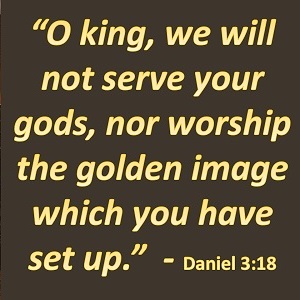
“Shadrach, Meshach, and Abednego answered the king, Nebuchadnezzar, we have no need to answer you in this matter. If it be so, our God whom we serve is able to deliver us from the burning fiery furnace; and he will deliver us out of your hand, O king. But if not, be it known to you, O king that we will not serve your gods, nor worship the golden image which you have set up.” Daniel 3:16–18

faithful under pressureintegrity


These three men were surrounded by the strongest coercive forces the empire could assemble. Spectacle did not move them. Music did not move them. The crowd did not move them. The king’s favor did not seduce them. The king’s rage did not break them. The furnace did not silence them. How is that possible?


Some might say, “They had religion.” However, everyone in that scene had religion. The Babylonians had gods. The conquered nations had their own gods. The officials bowing before the image had religious backgrounds of their own of one kind or another. But under pressure, they all bowed.


So what made these three men different?


They had integrity. Not merely the integrity of being honest men, though they were that. Not merely the integrity of keeping rules, though they did that too.


They had integrity in the deeper sense of wholeness. A person with integrity is not divided inside. He is not one thing in private and another thing in public. He is not loyal to YHWH in prayer but loyal to Babylon in worship. His inner life and outer life are joined together.


That is what we see in HananYah, Misha’El, and AzarYah. They were whole within. This kind of integrity goes beyond knowing what you believe. It means becoming what you believe. There is a very big difference between the two. A person may know the right answer and still bow in fear. A person may sing the songs of faith and still surrender when the music of the empire begins to play.


But a person who has become whole before YHWH has a different center. He is not deciding at the last minute who he is. That question has already been settled. So when the pressure comes, he does not need to invent courage on the spot. He simply remains what he has already become. These three Hebrews were Covenant men inside out, upside down, and through and through. Their relationship with YHWH was not a vague religious feeling. It was not merely an inherited tradition. It was a living covenant relationship with specific commandments, specific boundaries, specific promises, and specific love.


The Covenant demands exclusive worship of YHWH and the entire being of men like this cannot abide even the thought of disloyalty. It is antithetical to their very being. They simply will not do it for any reason. Period.


This is why their answer was so strong and so calm. They did not say, “We are sure God will do exactly what we want.” They said, “Our God is able to deliver us.”


Then they added three words that reveal the depth of their faith: “But if not.”


That is covenant faith at full strength. It trusts YHWH’s power without trying to control God’s decision. It believes in deliverance without making obedience dependent on deliverance. It says, “YHWH is able to save us, but even if He does not, we will not betray Him.”


To these men, bowing would not merely have been a mistake. It would have been a betrayal of the deepest truth of their lives. To bow would have been to say that survival mattered more than covenant faithfulness. For them, that was unthinkable.


And this is where Daniel 3 becomes very personal. I know some people may read this and feel challenged. I do too. This is a high bar. But it is the bar Yeshua set by His own example: wholeness, faithfulness, truth in the inward parts, love for YHWH above everything else.


The good news is that YHWH does not call us to become whole by our own strength. These men did not become covenant men in one dramatic moment on the plain of Dura. They became that through the Word, through the Spirit, through covenant, through atonement, through grace, through daily faithfulness, through walking with God before the crisis came. Most of us want courage in the crisis. But courage in the crisis must be formed before the crisis.


YHWH commands His people to be made whole in this sense. Don’t let the word “perfect” freak you out in this verse: “You shall be perfect with YHWH your God.” Deuteronomy 18:13


The word “perfect” here means “Someone or something that is whole, complete or full. Strong’s even uses the word “integrity” to describe the Hebrew word. This is about inner consistency of character, not necessarily perfection in the sense of being ideal in every way.  (Strong’s #8549: AHLB#: 1496-B)


You can be whole. Teachable. Faithful. Undivided. A person who can stand in a confused age because their identity has already been settled in Messiah. Paul says:

“If then you were raised together with Messiah, seek the things that are above, where Messiah is, seated on the right hand of God. Set your mind on the things that are above, not on the things that are on the earth. For you died, and your life is hidden with Messiah in God. When Messiah, our life, is revealed, then you will also be revealed with him in glory.” Colossians 3:1–4

And again:

“Seeing that you have put off the old man with his doings, and have put on the new man, who is being renewed in knowledge after the image of his Creator. Colossians 3:9–10

That is the answer. Your true identity is to be found in Messiah. Be that person. Seek out His help to grow in that identity, until you are whole, completely integrated within as that person you are meant to be. That is being perfect. That is having integrity.  


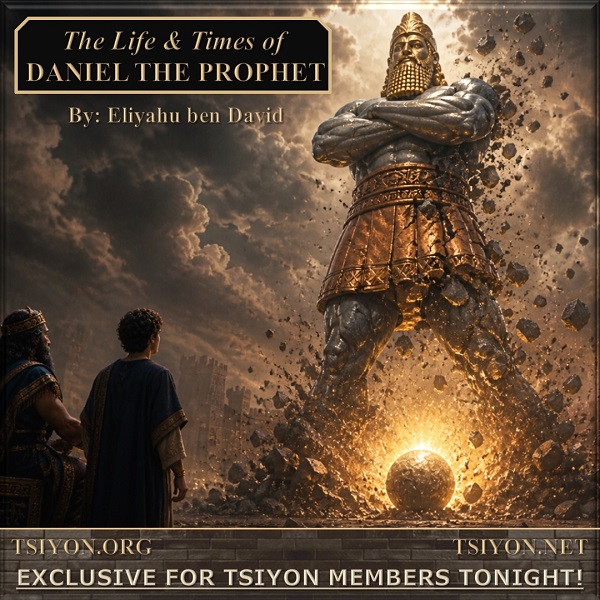
I have so much more to say, but this is probably already getting too long for a newsletter. I didn’t even get to the end of the story about HananYah, Misha’El, and AzarYah yet. You can get that and a lot more tonight in our exclusive broadcast for our Tsiyon Members at Tsiyon.Net.


My theme will be: The Life & Times of Daniel the Prophet. 


Getting to know Daniel better as a person will give you new insight into the prophetic content of the Book of Daniel, not to mention the fact that everything about Daniel is interesting and even entertaining. Please join me tonight, May 15, 2026, 8 PM Central, only at Tsiyon.Net, and no other streaming platforms, for this exclusive content. You are sure get some new insights.


In His Name, Eliyahu 


PS - Don't miss the new music in our program tonight!


Contact:   https://tsiyon.org  -  https://eliyahubendavid.substack.com/

TSIYON MEMBERS ONLY!   -   5/15/26   -   TSIYON.NET

Tsiyon Members Invited

Audio: Listen to Tsiyon RadioTsiyon Radio on TuneInSpeakerStitcher.comVideo & Audio PodcastsSpotifyGoogle Video Podcasts

Video:  FaceBookTwitterRokuYouTubePeriscopeTwitchDive.TVPodChaser

PodBeanBuzzSproutApple Video PodcastsTruthPoint Video ChannelSee TruthPoint Videos!Eliyahu ben David Author Page


"The nations shall know that I am YHWH,

when I shall be sanctified in you before their eyes." Eze 36:23


Thanks to our Tsiyon Ministry Partners for your support of this ministry!
Not a Tsiyon Ministry Partner yet? Visit our Tsiyon
Website for full details.

Copyright 2026 Tsiyon

Leave feedback, prayer requests and comments here.  You may unsubscribe here.

Please help keep Tsiyon on the air! 

 Click to Donate 

Tsiyon

9901 Brodie Lane

Suite 160, Unit 1421

Austin, TX, USA, 78748


Please make offering checks to: "Tsiyon."