From Eliyahu
UFOs: Space-Age Mask of an Ancient Deception
Rather suddenly "Disclosure" appears to be imminent. For the
first time the idea of extra-terrestrial beings visiting earth is being
legitimized in the public consciousness by mainstream news organizations and
even government figures. This newsletter is the first in a ten part series
that will unpack the facts, and expose the spiritual implications of this
ongoing mind-altering media campaign.
Part 1: UFO Does Not Mean Alien
When most people hear the word “UFO,” they immediately think of aliens.
A strange light moves across the night sky. A pilot reports an object he
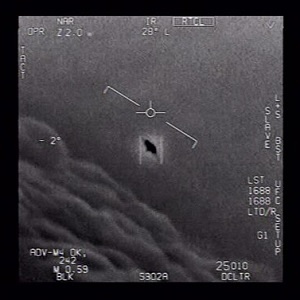
cannot identify. A military video shows something unusual moving in a way
that seems difficult to explain. The public hears the story and almost
instantly the same question appears: “Are we being visited by beings from
another planet?” But that connection is not proof. It is interpretation.
A UFO is simply an unidentified flying object. The newer term, UAP, is often
used now because it is broader: unidentified anomalous phenomenon. Either
way, the word “unidentified” means exactly that. It means the observer,
investigator, camera, radar system, or agency has not yet identified what
was seen. It does not mean “alien spacecraft.”
That distinction is important. For decades, popular culture has trained
people to make a leap from “unidentified” to “extraterrestrial.” Movies,
television, books, documentaries, interviews, and government rumors have all
worked together to build a mythology in the public mind. We have been taught
to imagine that strange things in the sky are visitors from distant worlds.
Even scientists have contributed to the idea that there must be intelligent
life on many planets throughout the universe. For example, we have this
quote from the famous Stephen Hawking: "Considering the number of planets
and stars that we know exist, it's extremely unlikely that we are the only
form of evolved life."
This sounds persuasive because the numbers are so large. But the argument
assumes what has not been proven: that life naturally arises from nonliving
matter when the conditions appear suitable. Yet scientific literature
admits: "The emergence of life from nonlife, or abiogenesis, remains a
fundamental question in scientific inquiry." https://pubmed.ncbi.nlm.nih.gov/39159441/
Without proof that life can spring from nonlife, the vastness of the
universe does not prove the abundance of life, the Drake Equation not
withstanding. We
should not be quick to accept the interpretation handed to us by popular
culture or from wishful thinking with no basis in fact - even if coming from
famous scientists. As NASA has stated: "..extraterrestrial presence on
regular display is, of course, a fiction. No life beyond Earth has ever been
found; there is no evidence that alien life has ever visited our planet.
It’s all a story."
https://astrobiology.nasa.gov/about/?
So when it comes to UFOs a Bible believer should ask better questions. What
was actually seen? What is documented? What is being assumed? What message
is attached to the event? And most importantly: what spirit is behind that
message?
The Modern Flying-Saucer Age
The modern UFO age is usually traced to 1947, when pilot Kenneth Arnold
reported seeing nine strange objects near Mount Rainier. His description
helped give the public the phrase “flying saucer.” From there, the
flying-saucer idea exploded into the public imagination.
This does not mean nothing strange was ever reported before 1947. It means
that 1947 became the beginning of the modern UFO mythology: flying discs,
government secrecy, crashed saucers, alien visitors, contactees, and later,
abductions. Once that mythology took hold, people were given a ready-made
explanation for the unknown. If something strange appeared in the sky, the
question was no longer simply, “What was that?”
The question became, “Was that an alien spacecraft?”
That is a very different question. It already assumes the most sensational
possibility.
The Distance Problem
There is also a major practical problem with the extraterrestrial
explanation: distance. We do not live in a Star Trek universe. The stars are
not nearby. Even the nearest star systems are unimaginably distant by human
travel standards.
The closest known exoplanet often discussed in relation to possible
habitability is Proxima Centauri b, orbiting the nearest star system beyond
our own. It is about 4.2 light-years away. A light-year is not a measure of
time. It is the distance light travels in one year - about 5.88 TRILLION
miles. That means even the nearest candidate world is more than TWENTY-FOUR
TRILLION MILES AWAY. At known spacecraft speeds, the trip would take
thousands of years or longer. What craft could be built that would even
function that long? What about food and supplies? What about radiation and
other space hazards? How could generations of people be sustained over many
generations in a glorified tin can? The entire idea is an obvious fiction.
The real facts being what they
are, we
should be very cautious about assuming that beings from other star systems
are routinely visiting earth, entering our atmosphere, hovering near
military bases, abducting people, and delivering messages to contactees, as
if the closest earth-like planet is right next door. It’s not. Yes, people
are seeing unidentified objects in the sky, but it does not naturally follow
that they are from anywhere but here.
What Do Official Reports Actually Say?
In recent years, the subject of UAPs has moved from fringe discussion into
official government reporting. That is significant. Military pilots, radar
systems, intelligence agencies, and congressional committees have taken the
matter seriously enough to study it. But official interest does not equal
proof of aliens.
In fact, public government reports have been cautious. Some cases remain
unresolved. Some are explained as balloons, drones, aircraft, atmospheric
effects, sensor errors, or insufficient data. Others remain unidentified
because the evidence is too limited to make a confident judgment. That is
not the same thing as saying, “They are from another planet.” It simply
means there are things people have not identified.
The wise response is neither gullibility nor mockery. We should not laugh at
every witness - they probably saw something. But neither should we accept
the alien interpretation simply because the event is strange. A Bible
believer should be able to say: “Yes, something may have been seen. But no,
that does not mean the explanation is extraterrestrial.” This is where
discernment begins.
Other Possibilities
If UAP does not automatically mean alien, then what else might be involved?
There are several possibilities. Some sightings may be natural phenomena:
stars, planets, meteors, unusual clouds, lightning-related effects,
atmospheric reflections, or other sky events. Some may be ordinary human
technology: aircraft, drones, balloons, satellites, rockets, flares, or
experimental equipment. Some may be secret human technology. Governments
have always developed weapons, aircraft, surveillance platforms, and
electronic systems in secrecy. It would be naive to think the public knows
everything being tested in the sky.
Some sightings may involve psychological or perceptual factors. People can
misjudge distance, speed, size, and altitude, especially at night or under
stress. Cameras and sensors can also create misleading impressions. Some
sightings may involve deception. A strange event can be used to manipulate
public belief, cover classified technology, or prepare people to accept a
larger narrative.
Finally, some
may involve spiritual realities. The unseen realm is real. There are
spiritual powers that deceive. There are forbidden forms of contact. There
are signs and wonders that are not from God. We should all be aware of this.
This does not mean every strange light is a demon. That would be careless.
But it does mean Bible believers must not let modern language blind us to
ancient patterns of deception. This is key.